
Key answer
Start with AI by framing the decision you want to improve, then score candidate use cases on value, feasibility, data readiness, and risk, and pick one or two to do properly. Sequence the rest so each step funds the next, and govern from day one. The first move is choosing well, not buying fast.
The honest answer to “where do we start with AI?” is: start by choosing well, not by buying fast. Frame the decision you want to improve, score candidate use cases on value, feasibility, data readiness, and risk, and pick one or two to do properly. Sequence the rest so each step funds the next, and govern from day one. The first move is a choice, not a purchase.
Why the first choice matters most#
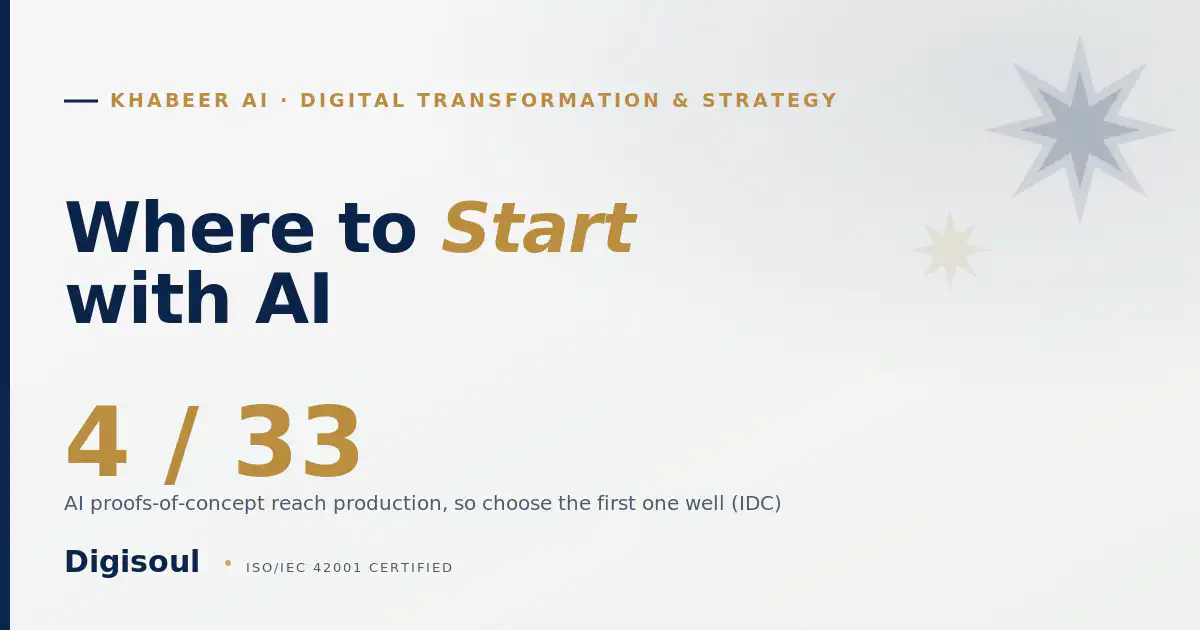
AI work is unforgiving of a bad starting point. Pick a use case with weak data or no clear value and it will stall no matter how good the tooling is. IDC found that for every 33 AI proofs-of-concept, only about 4 reach production, so the organizations that win are the ones that choose their first one or two use cases carefully.
AI proofs-of-concept that reach production, so the first choice matters most
The deeper pattern is the same. McKinsey reports 88% of organisations now use AI, but only about 6% are high performers, and just 21% have redesigned any workflow, the practice most tied to value. Choosing and sequencing the first use cases well, rather than buying more tools, is how you get into that minority.
The adoption-to-value gap
Where to start, in five steps#
Where to start, in five steps
Frame the decision you want AI to change. Inventory the data and process behind that decision, honestly. Score your candidate use cases on four criteria. Pick one or two and sequence the rest into a costed plan. Then govern from day one, with an owner, so the work can actually reach production.
Score on four criteria#
The scoring is what keeps you out of the demo trap.
Score on four criteria
A use case earns its place when it changes a decision worth real money, can be built and run with what you have, sits on data that exists and is trusted, and carries risk you can control. Anything that fails one of these goes back in the queue until the gap is closed. Once you have your shortlist, turn it into a sequenced plan, see How to Build an AI Roadmap.
How Khabeer helps#
Khabeer’s Digital Transformation and Strategy practice helps you frame the decision, score the use cases, and sequence the spend, independent and vendor-neutral, so the answer serves your goals rather than a vendor’s roadmap. The first step is a short conversation about the decision you want to improve and the data behind it.
Key takeaways
- Start by framing the decision to improve, not by choosing a tool.
- Score candidate use cases on value, feasibility, data readiness, and risk.
- Pick one or two to do properly and sequence the rest so each funds the next.
- Govern from day one and give the work an owner.
Questions, answered
What should my first AI project be?
Should we start small or go big?
How do we avoid choosing the wrong first project?
Why do most AI projects fail to scale?
Who should own the first project?
Dr. Ahmed El-Shamy
Co-founder, CEO and Dean of Education, Digisoul
Dr. Ahmed El-Shamy is Co-founder, CEO and Dean of Education at Digisoul. He has more than a decade across AI, fraud risk, and FP&A, and teaches Practical GenAI in FP&A bilingually across MENA, the GCC, and Africa, governed by Digisoul's ISO/IEC 42001:2023-certified AI Management System. Read the leadership profile.
Sources
- IDC (Lenovo CIO Playbook 2025), via CIO: about 4 of every 33 AI POCs reach production. https://www.cio.com/article/3850763/88-of-ai-pilots-fail-to-reach-production-but-thats-not-all-on-it/
- MIT (NANDA), State of AI in Business 2025, via Fortune: ~95% of enterprise GenAI pilots fail to deliver measurable impact. https://fortune.com/2025/08/18/mit-report-95-percent-generative-ai-pilots-at-companies-failing-cfo/
- McKinsey: The State of AI 2025 (88% use AI; ~6% high performers; only 21% have redesigned any workflow). https://www.mckinsey.com/capabilities/quantumblack/our-insights/the-state-of-ai
AI Agent · Built on Claude · Operated on Zoho One