
Key answer
An AI roadmap turns scattered tool spend into a costed, sequenced plan. You diagnose where you are, prioritize use cases by value, feasibility, data readiness, and risk, then sequence and cost them so each step funds the next. Without a roadmap, budget goes to demos that never change a decision.
An AI roadmap turns scattered tool spend into a costed, sequenced plan. Instead of buying whatever demoed well this quarter, you diagnose where you are, prioritize use cases by value, feasibility, data readiness, and risk, then sequence and cost them so each step funds the next. The roadmap is what stops a budget from leaking into a drawer full of half-finished pilots.
The scattered-spend problem#
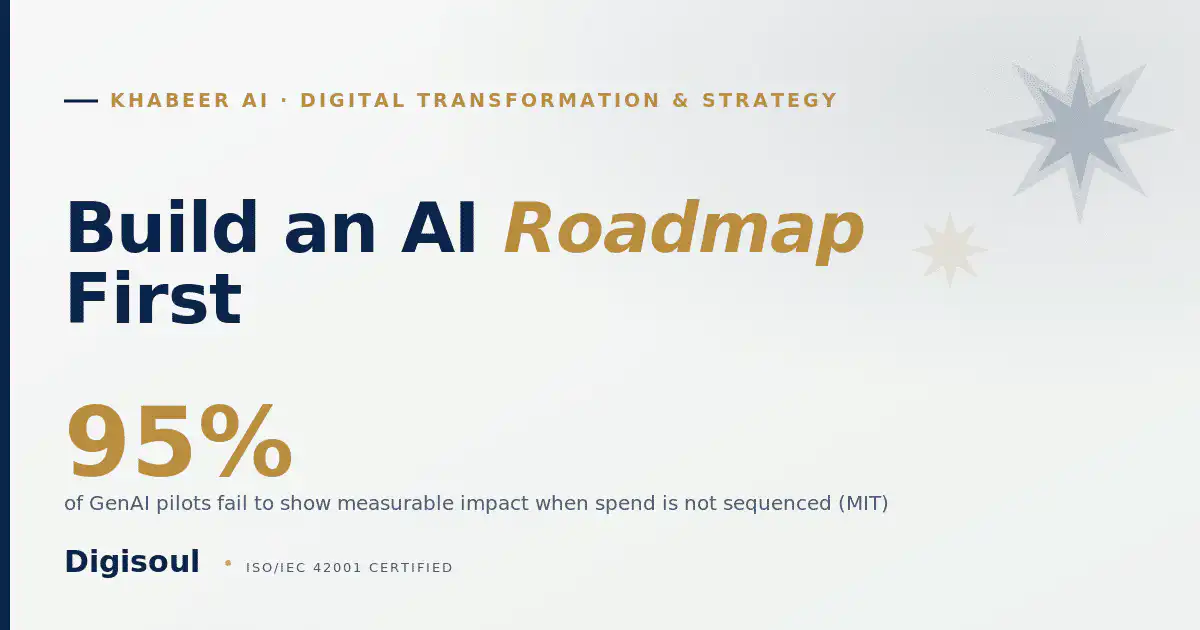
Most organizations do not have an AI budget problem. They have an AI focus problem. Spend goes to tools that impressed in a meeting, work starts in five places at once, and a year later there is plenty of activity and very little in production. MIT found that about 95% of enterprise GenAI pilots fail to deliver measurable impact, and a large part of the reason is that the spend was never tied to value or sequenced. The stakes are real: BCG finds only 5% of firms are AI value leaders, capturing 1.5 times the revenue growth of the 60% who lag, and PwC estimates GenAI could add around 23.5 billion US dollars a year to the GCC by 2030. Sequencing decides which side of that gap you land on.
of enterprise GenAI pilots fail to deliver measurable impact without a sequenced plan
AI value is concentrated; sequencing decides your side
Why AI spend scatters#
It is worth naming the leaks, because each one is avoidable.
Why AI spend scatters
Spending is tool-led instead of value-led. There is no sequence, so effort spreads thin. Readiness is never checked, so things are built before the data and process can support them, echoing the readiness gap behind IDC’s finding that only about 4 of 33 proofs-of-concept reach production. And no one owns the outcome.
From scatter to a costed roadmap#
A roadmap fixes the focus problem in four moves.
From scatter to a costed roadmap
You diagnose where you are by function, prioritize use cases against value, feasibility, data readiness, and risk, then sequence and cost them into a funded order of work, with owners and a review rhythm. Each step is chosen so it funds and de-risks the next, which is how a limited budget compounds instead of evaporating. If you are still deciding where to begin, read Where to Start with AI.
How Khabeer helps#
Khabeer’s Digital Transformation and Strategy practice sequences spend into a costed roadmap, independent and vendor-neutral, so the plan serves your outcomes rather than a platform’s roadmap. In one illustrative example (hypothetical, not a real client), an organization replaces a scattered set of tool trials with a sequenced, costed plan and funds the two initiatives that change a real decision. The starting point is a short diagnostic conversation about where your budget is going and what you want it to change.
Key takeaways
- A roadmap turns scattered tool spend into a sequenced, costed plan tied to value.
- Prioritize by value, feasibility, data readiness, and risk, not by which tool demos best.
- Sequence the work so each step funds and de-risks the next.
- Give every initiative an owner; unowned AI spend is wasted AI spend.
Questions, answered
What is an AI roadmap?
Why do we need a roadmap before buying AI tools?
Where does AI value actually land?
How long does it take to build one?
We are an SME, is this overkill?
Dr. Ahmed El-Shamy
Co-founder, CEO and Dean of Education, Digisoul
Dr. Ahmed El-Shamy is Co-founder, CEO and Dean of Education at Digisoul. He has more than a decade across AI, fraud risk, and FP&A, and teaches Practical GenAI in FP&A bilingually across MENA, the GCC, and Africa, governed by Digisoul's ISO/IEC 42001:2023-certified AI Management System. Read the leadership profile.
Sources
- MIT (NANDA), State of AI in Business 2025, via Fortune: ~95% of enterprise GenAI pilots fail to deliver measurable impact. https://fortune.com/2025/08/18/mit-report-95-percent-generative-ai-pilots-at-companies-failing-cfo/
- IDC (Lenovo CIO Playbook 2025), via CIO: about 4 of every 33 AI POCs reach production, a readiness gap. https://www.cio.com/article/3850763/88-of-ai-pilots-fail-to-reach-production-but-thats-not-all-on-it/
- BCG: The Widening AI Value Gap (5% leaders capture 1.5x revenue growth; 60% lag) (Sep 2025). https://www.bcg.com/press/30september2025-ai-leaders-outpace-laggards-revenue-growth-cost-savings
- PwC Strategy&: GenAI could add ~USD 23.5bn/year to the GCC by 2030. https://www.strategyand.pwc.com/m1/en/strategic-foresight/sector-strategies/technology/reshaping.html
AI Agent · Built on Claude · Operated on Zoho One