
Key answer
Build an automation business case by picking one repetitive process, baselining its current cost in hours and errors, estimating the savings, and modeling ROI and payback. Credible programs report strong returns, a Forrester study found a 248% three-year ROI with payback under six months, but the case must be specific to your process and include the cost to govern and run it.
A credible automation business case is specific, not generic. It starts with one repetitive process, baselines what that process costs you today in hours and errors, estimates the savings, and models the ROI, the payback, and the cost to run it. External benchmarks are encouraging, a Forrester study found a 248% three-year ROI with payback under six months, but the number that convinces a CFO is the one built on your own process.
Why generic ROI claims fail#
Vendor ROI figures impress in a slide and collapse in a finance review, because they are not your numbers. The fix is to build the case bottom-up on a single process you understand, so every assumption can be defended.
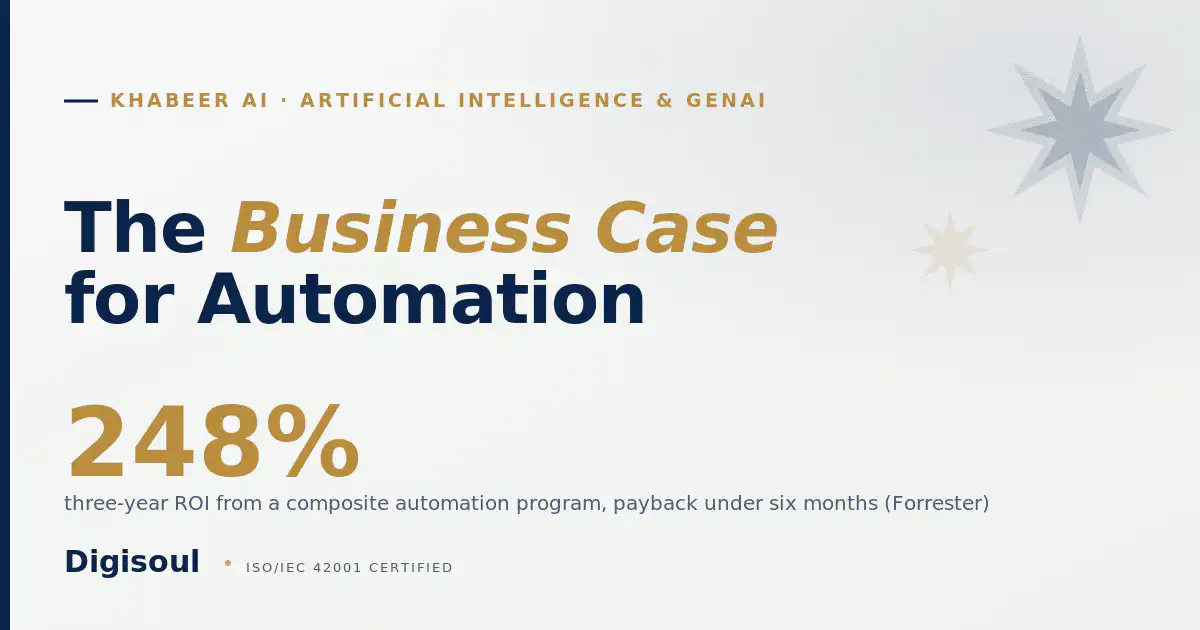
three-year ROI from a composite automation program, with payback in under six months
Five steps to a credible case#
Five steps to a credible case
Pick one repetitive, high-volume process. Baseline its current cost in hours and errors. Estimate the time and error savings automation would deliver. Model the ROI, payback, and the cost to run and govern it. Then add controls and a named owner, because an automation nobody owns will not deliver the savings you modeled.
Where the return comes from#
Quantify four sources, and the case writes itself.
Where the return comes from
Hours returned as staff time is freed from repetitive steps. Fewer errors, so rework and exceptions fall. Faster cycle time, so work finishes in hours rather than days. And freed capacity, as people move to higher-value work. The benchmark is encouraging: finance teams adopting AI report it returning an average of 21 hours a week, with 75% seeing fewer errors (BILL, 2026). Net the run and governance cost against these, and you have a number that survives scrutiny.
saved per week on average by finance teams adopting AI, with 75% reporting fewer errors
How Khabeer helps#
Khabeer’s Artificial Intelligence and GenAI practice builds the prioritized, costed business case and then implements it under governance, independent and vendor-neutral, with one accountable partner across strategy, build, and run. Once the case is made, the next question is scope, see Which Back-Office Work to Automate First. The first step is a short conversation about the process you most want off your team’s desk.
Key takeaways
- Build the case on one specific process, not a generic ROI promise.
- Baseline current cost in hours and errors before estimating savings.
- Quantify four sources: hours returned, fewer errors, faster cycle time, freed capacity.
- Include the cost to govern and run it, or the ROI is fiction.
Questions, answered
What ROI can automation deliver?
How do I build the business case?
What do people forget to include?
How much time does automation actually save?
Which process should we automate first?
Dr. Ahmed El-Shamy
Co-founder, CEO and Dean of Education, Digisoul
Dr. Ahmed El-Shamy is Co-founder, CEO and Dean of Education at Digisoul. He has more than a decade across AI, fraud risk, and FP&A, and teaches Practical GenAI in FP&A bilingually across MENA, the GCC, and Africa, governed by Digisoul's ISO/IEC 42001:2023-certified AI Management System. Read the leadership profile.
Sources
- Forrester Total Economic Impact, via Blue Prism: composite 248% three-year ROI, payback under six months. https://www.blueprism.com/automation-journey/calculate-rpa-roi/
- BILL: 2026 State of AI in Finance (AI saves ~21 hours/week; 75% report fewer errors). https://www.bill.com/blog/state-of-ai-finance-report-takeaways
AI Agent · Built on Claude · Operated on Zoho One