
AI Governance & Artificial Intelligence Management System (AIMS)
Effective Date: 2 June 2026 | Version: 2.0 | Jurisdiction: Arab Republic of Egypt
Operator & Legal Identity: This website and its products and services are operated by Digisoul For AI Services, a sole proprietorship (individual establishment) registered in the Arab Republic of Egypt under Commercial Register No. 35844 (Unified Commercial Register No. 10610.08000.35844) and Tax Registration No. 775-402-346. Registered office: Office A, 2nd Floor, 53 Capital Mall (behind the Court), Fifth Settlement (New Cairo), Cairo Governorate, Egypt.
Summary: Artificial intelligence is at the core of how Digisoul designs, builds, and optimises digital experiences across our five-pillar ecosystem — training (AI4X, Skills4X), digital products (Brain, AI4X Prompt Library), advisory (Khabeer AI), agentic SaaS (JafarOS), and community (Diwan AI). This policy describes our Artificial Intelligence Management System (AIMS): how we keep every AI-powered solution safe, transparent, lawful, and measurably valuable, with human accountability over consequential decisions. Our AIMS is independently certified to ISO/IEC 42001:2023 and operated in line with Egyptian law and recognised responsible-AI principles.
At Digisoul, the use of AI carries a clear obligation: every AI-powered solution we create — for ourselves and for our clients — must be safe, transparent, compliant, and measurably valuable. This policy explains how we establish and operate an Artificial Intelligence Management System (AIMS) aligned with internationally recognised standards, including ISO/IEC 42001:2023, and how we turn responsible-AI principles into daily practice. It is not a substitute for the standard; it is our operational expression of it.
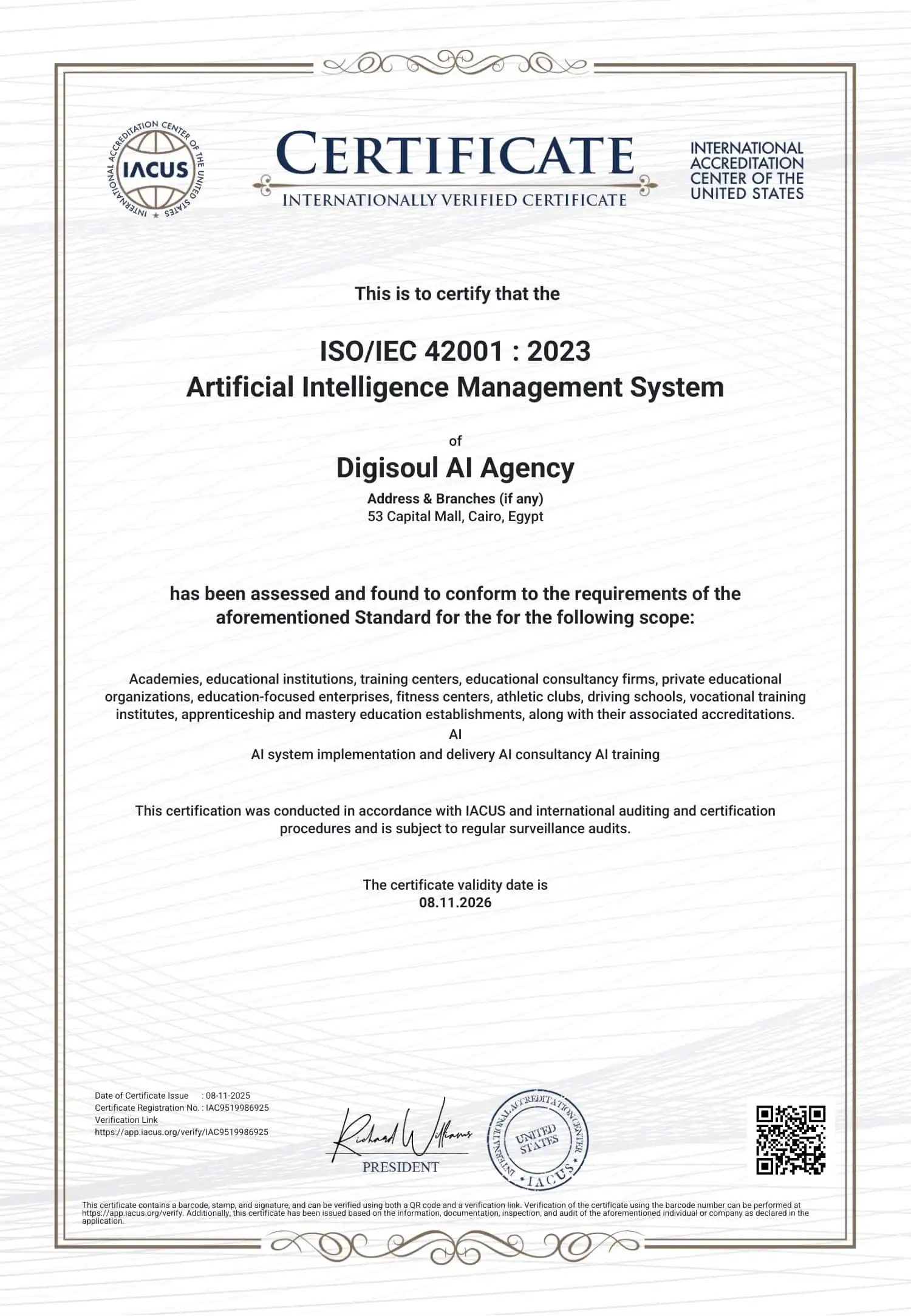
ISO/IEC 42001:2023 — Certified AI Management System
Digisoul’s Artificial Intelligence Management System (AIMS) has been independently assessed and certified to ISO/IEC 42001:2023 by IACUS (International Accreditation Center of the United States) — the formal evidence behind the governance practices described on this page.
1. Scope of Our AI Management System (AIMS)
Digisoul’s AIMS applies to all AI-related activities, solutions, and services that we design, implement, host, or manage, whether for our own use or for clients across our training, digital-products, advisory, agentic-SaaS, and community pillars.
1.1 Services & Solutions in Scope
- AI-Powered Marketing & Personalisation: recommendation engines, dynamic content, segmentation, and automation flows.
- AI Content, SEO & AEO Systems: tools and workflows that generate, optimise, or analyse content for search and answer engines.
- AI-Enhanced Websites & Experience Layers: intelligent sites, chatbots, forms, personalisation widgets, and analytics-driven UX.
- AIOps & Automation Frameworks: orchestrations that use AI/ML or LLMs for monitoring, enrichment, routing, anomaly detection, or decision support.
- AI Training & Advisory: programmes and playbooks (including AI4X, Skills4X, and Khabeer AI advisory) where Digisoul recommends or configures AI tools, governance models, or automation strategies for clients.
1.2 Assets & Activities Covered
- AI models (first-party where applicable) and configurations of third-party models.
- Prompt libraries, workflows, and orchestration logic we design or deploy.
- Data pipelines feeding AI systems (including logs, events, customer and content data) where Digisoul has design or operational influence.
- Processes for vendor selection, risk assessment, testing, deployment, monitoring, incident handling, and decommissioning of AI-powered solutions.
Client-managed AI systems fully outside Digisoul’s control fall outside this AIMS but are considered in our consulting guidance and risk advisories.
2. Our AI Governance Principles
Our AIMS is built on clear, operational principles that guide every AI use case:
- Lawful & Compliant: we design AI to comply with applicable laws and standards, including data protection, consumer protection, intellectual property, accessibility, and advertising rules.
- Human-Centric & Beneficial: AI must enhance human decisions and experiences, not replace accountability or exploit vulnerabilities. We do not deploy fully autonomous decision-making over matters that significantly affect individuals.
- Privacy & Data Minimisation: only the minimum necessary data is processed; personal data is protected using appropriate technical and organisational measures, consistent with Personal Data Protection Law No. 151/2020 and its Executive Regulations.
- Fairness & Non-Discrimination: we assess AI use cases for potential bias and take steps to prevent discriminatory outcomes in design, training, and deployment.
- Transparency & Explainability: we aim to give clients and end-users meaningful information about when and how AI is used, the purpose it serves, and its limitations.
- Security & Robustness: AI systems must be resilient against misuse, adversarial prompts, data leaks, and unintended behaviour.
- Human Oversight & Accountability: clear owners are assigned for AI systems, decisions, and risk controls, with meaningful human review wherever outputs materially affect individuals. “The system did it” is never an acceptable justification.
- Continuous Improvement: controls, models, prompts, and policies are monitored, reviewed, and improved using a structured feedback loop.
3. Governance Structure & Accountable Roles
Digisoul operates a layered AI governance model to ensure decisions are owned, traceable, and auditable.
3.1 AI Governance Council (AIGC)
A cross-functional council that provides strategic direction and oversight for all AI initiatives.
- Approves AIMS scope, policies, and key AI use cases.
- Reviews AI risk reports, incidents, and continuous-improvement actions.
- Ensures alignment with Digisoul’s mission, legal obligations, and partner expectations.
3.2 AIMS Lead / AI Governance Lead
- Day-to-day owner of the AIMS framework.
- Coordinates risk assessments, lifecycle controls, and internal audits.
- Reports status and issues to the AI Governance Council.
3.3 Product & Solution Owners
- Own specific AI-enabled offerings (e.g. marketing automation, AI content engines, AI UX layers).
- Ensure each solution complies with this policy and its approved risk level.
- Maintain documentation: use-case description, data flows, vendors, controls.
3.4 Data Protection & Security Leads
- Evaluate privacy, security, and data-residency implications of AI use.
- Review data-processing agreements and technical safeguards with vendors.
- Support incident response for AI-related security or privacy events.
3.5 Delivery & Engineering Teams
- Implement AI systems according to approved designs and controls.
- Apply secure development, testing, and monitoring practices.
- Log issues, anomalies, and improvement opportunities.
3.6 Partners & Suppliers
- Are expected to adhere to equivalent responsible-AI standards.
- Undergo selection and review processes aligned with this AIMS.
4. Alignment with ISO/IEC 42001:2023 & the PDCA Cycle
Digisoul structures its AIMS following the Plan–Do–Check–Act (PDCA) methodology used in ISO management-system standards, including ISO/IEC 42001:2023, to which our AIMS is certified. This policy is not a substitute for the standard; it is our operational expression of it.
4.1 Plan
- Define AI strategy, objectives, and risk appetite.
- Identify internal and external requirements (laws, standards, client obligations).
- Maintain an AI Systems & Use-Case Register with owners and risk levels.
- Establish policies on data, vendors, security, ethics, and lifecycle.
4.2 Do
- Design and implement AI solutions according to approved requirements.
- Apply secure-development and privacy-by-design principles.
- Train teams on responsible AI and AIMS procedures.
4.3 Check
- Monitor AI-system performance, safety, and compliance.
- Conduct internal reviews and spot-checks on high-impact use cases.
- Track incidents, complaints, and non-conformities.
4.4 Act
- Update models, prompts, configurations, and processes based on findings.
- Adjust policies, controls, and training where gaps are found.
- Continuously improve the AIMS to reflect new risks, regulations, and technologies.
5. AI Risk & Safety Framework
Our AI Risk & Safety approach ensures every AI initiative is evaluated and controlled proportionately to its potential impact on people, clients, and partners.
5.1 Risk Identification & Classification
- Each AI use case is documented: purpose, users, data sources, and decisions influenced.
- We evaluate potential impacts on privacy and confidentiality; fairness and discrimination; security and misuse; content integrity and reputation; and user autonomy and vulnerable groups.
5.2 Typical Controls
- Data controls: minimisation, masking, aggregation, access controls, and retention limits.
- Technical controls: guardrails on prompts, filtering, rate-limiting, environment isolation, logging, and monitoring.
- Organisational controls: approvals for high-impact use cases, segregation of duties, and documented SOPs.
- Human oversight: meaningful human review is required wherever outputs materially affect individuals or business-critical decisions; we do not rely on fully autonomous decisions in such cases.
- Vendor due diligence: security, privacy, compliance, and model-behaviour assurances where feasible.
5.3 Incident Management
AI-related issues (e.g. harmful outputs, security incidents, major bias indicators) are treated as formal incidents:
- Logged in our internal tracking system.
- Assessed for severity, root cause, and required remediation.
- Escalated to the AI Governance Council and, where applicable, to clients or authorities. Where an incident involves a personal-data breach, we follow the notification timelines in our Privacy Policy, including notification to the Personal Data Protection Centre (PDPC) within 72 hours of becoming aware, in line with Personal Data Protection Law No. 151/2020 and its Executive Regulations.
6. How We Design, Test & Monitor Our AI Systems
This section summarises how Digisoul turns governance into concrete lifecycle practices across AI use cases. It applies to both our internal solutions and client projects where we have design influence.
6.1 Use-Case Intake & Gating
- Every AI initiative starts with a documented use case: objectives, users, data, impact, and success metrics.
- We reject or redesign use cases that lack a lawful basis or clear value, target vulnerable groups in manipulative ways, or conflict with our ethical principles or client obligations.
6.2 Data Governance by Design
- Identify data categories (personal, sensitive, behavioural, content, logs).
- Prefer pseudonymised or aggregated data where possible.
- Ensure a lawful basis, contracts, and consents cover the intended AI processing, consistent with Personal Data Protection Law No. 151/2020.
- Restrict access to training and operational data on a need-to-know basis.
6.3 Model & Vendor Selection
- Select cloud/LLM providers and tools that meet security and privacy expectations.
- Evaluate documented safeguards against misuse and bias; data-usage terms (no unauthorised training on client data); and regional/legal compatibility where data residency matters.
6.4 Design & Implementation
- Apply modular architectures so AI components are controllable and auditable.
- Use prompt patterns and workflows with explicit instructions on safety, privacy, and tone, and constraints on disallowed content and actions.
- Tag AI-generated content or decisions where appropriate in client journeys.
6.5 Testing & Validation
- Scenario-based testing covering edge cases, stress conditions, adversarial prompts, and the language and cultural contexts relevant to our clients.
- Quality checks for accuracy against ground truth where available, and consistency with brand, compliance, and ethical rules.
- Bias and harm checks proportional to the use case, looking for systematically skewed or harmful outputs.
- Security and privacy checks for leakage risks, prompt-injection resilience, and access controls.
- Only after successful validation can a solution move to production.
6.6 Monitoring in Production
- Log key interactions and system behaviour in compliance with privacy rules.
- Track defined KPIs, such as output quality/relevance, error and override rates (how often humans correct AI), safety flags, user complaints, and anomalous usage.
- Run periodic sample reviews to detect drift, bias, or misuse.
- Update or roll back configurations when thresholds are breached.
6.7 Decommissioning & Change Management
- Retire AI components through a controlled process: documentation, client notification (where applicable), and secure data handling.
- All major changes (models, providers, logic) follow documented change control with impact assessment.
7. Documentation, Training & Continuous Improvement
- Maintain internal records for AI systems, assessments, approvals, and incidents.
- Provide periodic training on AIMS, data protection, and ethical AI to relevant teams.
- Conduct internal reviews of the AIMS at least annually or after major changes.
- Refine controls based on lessons learned, client feedback, and regulatory updates.
8. Regulatory Framework (Egypt, 2026)
Our AIMS is operated in line with applicable Egyptian law and recognised responsible-AI principles, including:
- Personal Data Protection Law No. 151/2020 & its Executive Regulations (PM Decree 816/2025): lawful basis and explicit consent for personal-data processing, a transparent privacy notice, data-subject rights (including the right to object to processing, such as profiling), and breach notification to the Personal Data Protection Centre (PDPC) within 72 hours. See our Privacy Policy and Data Retention & User Rights.
- Anti-Cyber & Information Technology Crimes Law No. 175/2018: security, lawful use, and protection of information systems and data.
- ISO/IEC 42001:2023 — AI Management System: the standard to which Digisoul’s AIMS is independently certified.
- ISO/IEC 27001 information-security principles: our security practices are aligned with these principles to protect the data and systems underpinning our AI solutions.
- Recognised responsible-AI principles, consistent with the Egyptian Charter for Responsible AI and international frameworks (such as the UNESCO Recommendation on the Ethics of AI and the OECD AI Principles), which inform our governance approach.
This list is not exhaustive; we monitor regulatory developments — including Egypt’s evolving national AI governance framework — and update our controls accordingly.
9. Contact & Escalation
For questions about this AI Governance & AIMS Policy, or to raise a concern related to a Digisoul AI system, please contact us:
- Email: bd@digisoul.io (the contact point for all enquiries, including AI-governance, privacy, and data-protection requests)
- Phone: +20 100 020 9111
- Address: Cairo, Arab Republic of Egypt
- Support hours: we aim to respond within 1 business day, Sunday–Thursday 09:00–18:00 Cairo time (UTC+2).
For personal-data matters, you may also contact, or lodge a complaint with, the Personal Data Protection Centre (PDPC), the supervisory authority established under Personal Data Protection Law No. 151/2020.
10. Changes to This Policy
We may update this AI Governance & AIMS Policy from time to time to reflect changes in our practices, technologies, AIMS certification scope, or legal and regulatory requirements. The current version and its effective date are shown at the top of this page. Material changes will be posted on this page, and your continued use of our services after an update constitutes acceptance of the revised policy.
11. Governing Law & Jurisdiction
This policy is governed by the laws of the Arab Republic of Egypt. The competent courts of Cairo have exclusive jurisdiction over any dispute arising out of or in connection with it, without prejudice to any mandatory consumer-protection or data-subject rights available to you under Egyptian law.
© 2026 Digisoul — All Rights Reserved.
حوكمة الذكاء الاصطناعي ونظام إدارة الذكاء الاصطناعي (AIMS)
تاريخ السريان: 2 يونيو 2026 | الإصدار: 2.0 | الاختصاص القضائي: جمهورية مصر العربية
المُشغِّل والهوية القانونية: يُشغّل هذا الموقع ومنتجاته وخدماته «ديجيسول لخدمات الذكاء الاصطناعي» (Digisoul For AI Services)، وهي منشأة فردية مُقيَّدة بجمهورية مصر العربية بالسجل التجاري رقم 35844 (الرقم الموحّد للسجل التجاري 10610.08000.35844) ورقم التسجيل الضريبي 775-402-346. المقر المُسجَّل: مكتب A، الدور الثاني، 53 كابيتال مول (خلف المحكمة)، التجمع الخامس (القاهرة الجديدة)، محافظة القاهرة، مصر.
ملخص: يقع الذكاء الاصطناعي في صميم الطريقة التي تصمّم بها Digisoul التجارب الرقمية وتبنيها وتحسّنها عبر منظومتها ذات الركائز الخمس — التدريب (AI4X وSkills4X)، والمنتجات الرقمية (Brain ومكتبة AI4X Prompt Library)، والاستشارات (Khabeer AI)، وبرمجيات الوكلاء كخدمة (JafarOS)، والمجتمع (Diwan AI). تصف هذه السياسة نظام إدارة الذكاء الاصطناعي لدينا (AIMS): كيف نحافظ على أن يكون كل حل مدعوم بالذكاء الاصطناعي آمنًا وشفافًا ومشروعًا وذا قيمة قابلة للقياس، مع خضوع القرارات المؤثرة لمساءلة بشرية. ونظام إدارة الذكاء الاصطناعي لدينا معتمد بشكل مستقل وفقًا للمعيار ISO/IEC 42001:2023 ويُشغَّل بما يتوافق مع القانون المصري ومبادئ الذكاء الاصطناعي المسؤول المعترف بها.
في Digisoul، يرتّب استخدام الذكاء الاصطناعي التزامًا واضحًا: يجب أن يكون كل حل مدعوم بالذكاء الاصطناعي نُنشئه — لأنفسنا ولعملائنا — آمنًا وشفافًا ومتوافقًا وذا قيمة قابلة للقياس. توضّح هذه السياسة كيف نُنشئ ونُشغّل نظام إدارة الذكاء الاصطناعي (AIMS) بما يتماشى مع المعايير المعترف بها دوليًا، بما في ذلك ISO/IEC 42001:2023، وكيف نحوّل مبادئ الذكاء الاصطناعي المسؤول إلى ممارسة يومية. وهذه السياسة ليست بديلًا عن المعيار، بل هي تعبيرنا التشغيلي عنه.
1. نطاق نظام إدارة الذكاء الاصطناعي (AIMS)
ينطبق نظام إدارة الذكاء الاصطناعي الخاص بـ Digisoul على جميع الأنشطة والحلول والخدمات المتعلقة بالذكاء الاصطناعي التي نصممها أو ننفّذها أو نستضيفها أو نديرها، سواء لاستخدامنا الخاص أو لعملائنا عبر ركائز التدريب والمنتجات الرقمية والاستشارات وبرمجيات الوكلاء كخدمة والمجتمع.
1.1 الخدمات والحلول المشمولة بالنطاق
- التسويق والتخصيص المدعوم بالذكاء الاصطناعي: محرّكات التوصية، والمحتوى الديناميكي، والتقسيم، وتدفقات الأتمتة.
- أنظمة المحتوى وتحسين محركات البحث ومحركات الإجابة (SEO وAEO): الأدوات وسير العمل التي تُنشئ المحتوى أو تحسّنه أو تحلّله لمحركات البحث والإجابة.
- المواقع وطبقات التجربة المعزّزة بالذكاء الاصطناعي: المواقع الذكية، وروبوتات المحادثة، والنماذج، وعناصر التخصيص، وتجربة المستخدم المدفوعة بالتحليلات.
- أطر AIOps والأتمتة: عمليات التنسيق التي تستخدم الذكاء الاصطناعي/التعلم الآلي أو النماذج اللغوية الكبيرة للمراقبة، والإثراء، والتوجيه، واكتشاف الحالات الشاذة، أو دعم القرار.
- التدريب والاستشارات في الذكاء الاصطناعي: البرامج والأدلة التطبيقية (بما في ذلك AI4X وSkills4X واستشارات Khabeer AI) التي توصي فيها Digisoul أو تهيّئ أدوات الذكاء الاصطناعي أو نماذج الحوكمة أو استراتيجيات الأتمتة للعملاء.
1.2 الأصول والأنشطة المشمولة
- نماذج الذكاء الاصطناعي (المملوكة لنا حيثما ينطبق) وتهيئات نماذج الأطراف الثالثة.
- مكتبات المطالبات (Prompts)، وسير العمل، ومنطق التنسيق الذي نصممه أو ننشره.
- خطوط أنابيب البيانات التي تغذّي أنظمة الذكاء الاصطناعي (بما في ذلك السجلّات والأحداث وبيانات العملاء والمحتوى) حيثما يكون لـ Digisoul تأثير تصميمي أو تشغيلي.
- عمليات اختيار المورّدين، وتقييم المخاطر، والاختبار، والنشر، والمراقبة، ومعالجة الحوادث، وإيقاف تشغيل الحلول المدعومة بالذكاء الاصطناعي.
تقع أنظمة الذكاء الاصطناعي التي يديرها العميل وتخرج كليًا عن سيطرة Digisoul خارج نطاق هذا النظام، لكنها تؤخذ في الاعتبار ضمن إرشاداتنا الاستشارية وتوصياتنا المتعلقة بالمخاطر.
2. مبادئ حوكمة الذكاء الاصطناعي لدينا
يقوم نظام إدارة الذكاء الاصطناعي لدينا على مبادئ تشغيلية واضحة توجّه كل حالة استخدام للذكاء الاصطناعي:
- المشروعية والامتثال: نصمّم الذكاء الاصطناعي ليمتثل للقوانين والمعايير المعمول بها، بما في ذلك حماية البيانات، وحماية المستهلك، والملكية الفكرية، وإمكانية الوصول، وقواعد الإعلان.
- التمحور حول الإنسان وتحقيق النفع: يجب أن يعزّز الذكاء الاصطناعي القرارات والتجارب البشرية لا أن يحلّ محل المساءلة أو يستغل مواطن الضعف. ولا نعتمد اتخاذ قرارات مؤتمتة بالكامل في الأمور التي تؤثر تأثيرًا جوهريًا في الأفراد.
- الخصوصية وتقليل البيانات: تُعالَج البيانات بالحد الأدنى الضروري فقط؛ وتُحمى البيانات الشخصية باستخدام تدابير تقنية وتنظيمية مناسبة، بما يتوافق مع قانون حماية البيانات الشخصية رقم 151/2020 ولائحته التنفيذية.
- العدالة وعدم التمييز: نقيّم حالات استخدام الذكاء الاصطناعي بحثًا عن التحيّز المحتمل، ونتخذ خطوات لمنع النتائج التمييزية في التصميم والتدريب والنشر.
- الشفافية وقابلية التفسير: نسعى إلى تزويد العملاء والمستخدمين النهائيين بمعلومات ذات معنى حول متى وكيف يُستخدم الذكاء الاصطناعي، والغرض الذي يخدمه، وحدوده.
- الأمن والمتانة: يجب أن تكون أنظمة الذكاء الاصطناعي قادرة على الصمود أمام سوء الاستخدام، والمطالبات العدائية، وتسرّب البيانات، والسلوك غير المقصود.
- الإشراف البشري والمساءلة: تُسنَد ملكية واضحة لأنظمة الذكاء الاصطناعي وقراراتها وضوابط مخاطرها، مع مراجعة بشرية فعّالة حيثما تؤثر المخرجات تأثيرًا جوهريًا في الأفراد. وعبارة «النظام هو من فعل ذلك» ليست مبررًا مقبولًا أبدًا.
- التحسين المستمر: تُراقَب الضوابط والنماذج والمطالبات والسياسات وتُراجَع وتُحسَّن عبر حلقة تغذية راجعة منظّمة.
3. هيكل الحوكمة والأدوار المسؤولة
تُشغّل Digisoul نموذج حوكمة متعدد الطبقات للذكاء الاصطناعي لضمان أن تكون القرارات مملوكة وقابلة للتتبع والتدقيق.
3.1 مجلس حوكمة الذكاء الاصطناعي (AIGC)
مجلس متعدد الوظائف يوفّر التوجيه الاستراتيجي والإشراف على جميع مبادرات الذكاء الاصطناعي.
- يعتمد نطاق نظام إدارة الذكاء الاصطناعي وسياساته وحالات الاستخدام الرئيسية.
- يراجع تقارير مخاطر الذكاء الاصطناعي والحوادث وإجراءات التحسين المستمر.
- يضمن المواءمة مع رسالة Digisoul والالتزامات القانونية وتوقعات الشركاء.
3.2 مسؤول نظام إدارة الذكاء الاصطناعي / مسؤول حوكمة الذكاء الاصطناعي
- المالك اليومي لإطار نظام إدارة الذكاء الاصطناعي.
- ينسّق تقييمات المخاطر وضوابط دورة الحياة وعمليات التدقيق الداخلية.
- يرفع الحالة والمسائل إلى مجلس حوكمة الذكاء الاصطناعي.
3.3 مالكو المنتجات والحلول
- يمتلكون عروضًا محددة مدعومة بالذكاء الاصطناعي (مثل أتمتة التسويق، ومحرّكات المحتوى، وطبقات تجربة المستخدم).
- يضمنون امتثال كل حل لهذه السياسة ولمستوى المخاطر المعتمد له.
- يحافظون على التوثيق: وصف حالة الاستخدام، وتدفقات البيانات، والمورّدين، والضوابط.
3.4 مسؤولو حماية البيانات والأمن
- يقيّمون آثار الخصوصية والأمن وموطن البيانات المترتبة على استخدام الذكاء الاصطناعي.
- يراجعون اتفاقيات معالجة البيانات والضمانات التقنية مع المورّدين.
- يدعمون الاستجابة للحوادث الأمنية أو حوادث الخصوصية المتعلقة بالذكاء الاصطناعي.
3.5 فرق التسليم والهندسة
- تنفّذ أنظمة الذكاء الاصطناعي وفق التصاميم والضوابط المعتمدة.
- تطبّق ممارسات التطوير الآمن والاختبار والمراقبة.
- تسجّل المشكلات والحالات الشاذة وفرص التحسين.
3.6 الشركاء والمورّدون
- يُتوقَّع منهم الالتزام بمعايير مكافئة للذكاء الاصطناعي المسؤول.
- يخضعون لعمليات اختيار ومراجعة متوائمة مع هذا النظام.
4. المواءمة مع ISO/IEC 42001:2023 ودورة التخطيط–التنفيذ–التحقق–التصرّف (PDCA)
تبني Digisoul نظام إدارة الذكاء الاصطناعي وفق منهجية التخطيط–التنفيذ–التحقق–التصرّف (PDCA) المستخدمة في معايير أنظمة الإدارة الصادرة عن الـ ISO، بما في ذلك ISO/IEC 42001:2023 الذي يُعتمد نظامنا وفقًا له. وهذه السياسة ليست بديلًا عن المعيار، بل هي تعبيرنا التشغيلي عنه.
4.1 التخطيط
- تحديد استراتيجية الذكاء الاصطناعي وأهدافه ومدى تقبّل المخاطر.
- تحديد المتطلبات الداخلية والخارجية (القوانين والمعايير والتزامات العملاء).
- الاحتفاظ بـ سجل أنظمة وحالات استخدام الذكاء الاصطناعي مع المالكين ومستويات المخاطر.
- وضع سياسات تتعلق بالبيانات والمورّدين والأمن والأخلاقيات ودورة الحياة.
4.2 التنفيذ
- تصميم حلول الذكاء الاصطناعي وتنفيذها وفق المتطلبات المعتمدة.
- تطبيق مبادئ التطوير الآمن والخصوصية منذ التصميم.
- تدريب الفرق على الذكاء الاصطناعي المسؤول وإجراءات نظام إدارة الذكاء الاصطناعي.
4.3 التحقق
- مراقبة أداء أنظمة الذكاء الاصطناعي وسلامتها وامتثالها.
- إجراء مراجعات داخلية وفحوص عيّنية على حالات الاستخدام عالية التأثير.
- تتبّع الحوادث والشكاوى وحالات عدم المطابقة.
4.4 التصرّف
- تحديث النماذج والمطالبات والتهيئات والعمليات بناءً على النتائج.
- تعديل السياسات والضوابط والتدريب عند اكتشاف ثغرات.
- التحسين المستمر لنظام إدارة الذكاء الاصطناعي ليعكس المخاطر واللوائح والتقنيات الجديدة.
5. إطار مخاطر الذكاء الاصطناعي وسلامته
يضمن نهجنا في مخاطر الذكاء الاصطناعي وسلامته تقييم كل مبادرة والتحكم فيها بصورة متناسبة مع تأثيرها المحتمل في الأشخاص والعملاء والشركاء.
5.1 تحديد المخاطر وتصنيفها
- تُوثَّق كل حالة استخدام للذكاء الاصطناعي: الغرض، والمستخدمون، ومصادر البيانات، والقرارات المتأثرة.
- نقيّم الآثار المحتملة على الخصوصية والسرية؛ والعدالة والتمييز؛ والأمن وسوء الاستخدام؛ وسلامة المحتوى والسمعة؛ واستقلالية المستخدم والفئات المستضعفة.
5.2 الضوابط النموذجية
- ضوابط البيانات: التقليل، والإخفاء، والتجميع، وضوابط الوصول، وحدود الاحتفاظ.
- الضوابط التقنية: حواجز حماية على المطالبات، والتصفية، وتحديد المعدّل، وعزل البيئات، والتسجيل، والمراقبة.
- الضوابط التنظيمية: موافقات على حالات الاستخدام عالية التأثير، وفصل المهام، وإجراءات تشغيل قياسية موثّقة.
- الإشراف البشري: تُطلَب مراجعة بشرية فعّالة حيثما تؤثر المخرجات تأثيرًا جوهريًا في الأفراد أو في القرارات الحاسمة للأعمال؛ ولا نعتمد على قرارات مؤتمتة بالكامل في مثل هذه الحالات.
- العناية الواجبة تجاه المورّدين: ضمانات الأمن والخصوصية والامتثال وسلوك النماذج حيثما أمكن.
5.3 إدارة الحوادث
تُعامَل المسائل المتعلقة بالذكاء الاصطناعي (مثل المخرجات الضارة، والحوادث الأمنية، ومؤشرات التحيّز الكبيرة) باعتبارها حوادث رسمية:
- تُسجَّل في نظام التتبّع الداخلي لدينا.
- تُقيَّم من حيث الخطورة والسبب الجذري والمعالجة المطلوبة.
- تُصعَّد إلى مجلس حوكمة الذكاء الاصطناعي، وحيثما ينطبق، إلى العملاء أو الجهات المختصة. وحيثما يتضمّن الحادث خرقًا للبيانات الشخصية، نتّبع مواعيد الإخطار الواردة في سياسة الخصوصية الخاصة بنا، بما في ذلك إخطار مركز حماية البيانات الشخصية (PDPC) خلال 72 ساعة من العلم بالخرق، بما يتوافق مع قانون حماية البيانات الشخصية رقم 151/2020 ولائحته التنفيذية.
6. كيف نصمّم أنظمة الذكاء الاصطناعي لدينا ونختبرها ونراقبها
يلخّص هذا القسم كيف تحوّل Digisoul الحوكمة إلى ممارسات ملموسة عبر دورة حياة حالات استخدام الذكاء الاصطناعي. وينطبق على كل من حلولنا الداخلية ومشاريع العملاء التي يكون لنا فيها تأثير تصميمي.
6.1 استقبال حالات الاستخدام وبوّابات الموافقة
- تبدأ كل مبادرة للذكاء الاصطناعي بحالة استخدام موثّقة: الأهداف، والمستخدمون، والبيانات، والأثر، ومقاييس النجاح.
- نرفض أو نعيد تصميم حالات الاستخدام التي تفتقر إلى أساس قانوني أو قيمة واضحة، أو تستهدف الفئات المستضعفة بأساليب تلاعبية، أو تتعارض مع مبادئنا الأخلاقية أو التزامات العملاء.
6.2 حوكمة البيانات منذ التصميم
- تحديد فئات البيانات (الشخصية، والحساسة، والسلوكية، والمحتوى، والسجلّات).
- تفضيل البيانات المُسمّاة بأسماء مستعارة أو المجمّعة حيثما أمكن.
- التأكد من أن أساسًا قانونيًا والعقود والموافقات تغطّي معالجة الذكاء الاصطناعي المقصودة، بما يتوافق مع قانون حماية البيانات الشخصية رقم 151/2020.
- تقييد الوصول إلى بيانات التدريب والتشغيل على أساس الحاجة إلى المعرفة.
6.3 اختيار النماذج والمورّدين
- اختيار مزوّدي الخدمات السحابية/النماذج اللغوية والأدوات التي تستوفي توقعات الأمن والخصوصية.
- تقييم الضمانات الموثّقة ضد سوء الاستخدام والتحيّز؛ وشروط استخدام البيانات (عدم التدريب غير المصرّح به على بيانات العملاء)؛ والتوافق الإقليمي والقانوني حيثما يكون موطن البيانات مهمًّا.
6.4 التصميم والتنفيذ
- تطبيق بُنى معيارية بحيث تكون مكوّنات الذكاء الاصطناعي قابلة للتحكم والتدقيق.
- استخدام أنماط مطالبات وسير عمل تتضمّن تعليمات صريحة بشأن السلامة والخصوصية والنبرة، وقيودًا على المحتوى والإجراءات المحظورة.
- تمييز المحتوى أو القرارات المُولَّدة بالذكاء الاصطناعي حيثما كان ذلك مناسبًا في رحلات العملاء.
6.5 الاختبار والتحقق
- اختبار قائم على السيناريوهات يغطّي الحالات الحدّية، وظروف الإجهاد، والمطالبات العدائية، والسياقات اللغوية والثقافية ذات الصلة بعملائنا.
- فحوص جودة للدقة مقابل المرجعية الصحيحة حيثما توافرت، والاتساق مع قواعد العلامة التجارية والامتثال والأخلاقيات.
- فحوص التحيّز والضرر بما يتناسب مع حالة الاستخدام، بحثًا عن مخرجات منحازة أو ضارة بشكل منهجي.
- فحوص الأمن والخصوصية لمخاطر التسرّب، ومتانة الصمود أمام حقن المطالبات، وضوابط الوصول.
- لا يمكن نقل أي حل إلى مرحلة الإنتاج إلا بعد التحقق الناجح.
6.6 المراقبة في بيئة الإنتاج
- تسجيل التفاعلات الرئيسية وسلوك النظام بما يتوافق مع قواعد الخصوصية.
- تتبّع مؤشرات الأداء الرئيسية المحددة، مثل جودة/ملاءمة المخرجات، ومعدّلات الخطأ والتجاوز (كم مرة يصحّح البشر الذكاء الاصطناعي)، وإشارات السلامة، وشكاوى المستخدمين، والاستخدام الشاذ.
- إجراء مراجعات عيّنية دورية لاكتشاف الانحراف أو التحيّز أو سوء الاستخدام.
- تحديث التهيئات أو التراجع عنها عند تجاوز الحدود المقرّرة.
6.7 إيقاف التشغيل وإدارة التغيير
- إيقاف تشغيل مكوّنات الذكاء الاصطناعي عبر عملية مُحكَمة: التوثيق، وإخطار العميل (حيثما ينطبق)، والتعامل الآمن مع البيانات.
- تخضع جميع التغييرات الكبرى (النماذج، والمزوّدون، والمنطق) لضبط تغيير موثّق مع تقييم للأثر.
7. التوثيق والتدريب والتحسين المستمر
- الاحتفاظ بسجلّات داخلية لأنظمة الذكاء الاصطناعي والتقييمات والموافقات والحوادث.
- توفير تدريب دوري للفرق المعنية على نظام إدارة الذكاء الاصطناعي وحماية البيانات والذكاء الاصطناعي الأخلاقي.
- إجراء مراجعات داخلية لنظام إدارة الذكاء الاصطناعي مرة واحدة سنويًا على الأقل أو بعد التغييرات الكبرى.
- تحسين الضوابط بناءً على الدروس المستفادة، وملاحظات العملاء، والتحديثات التنظيمية.
8. الإطار التنظيمي (مصر، 2026)
يُشغَّل نظام إدارة الذكاء الاصطناعي لدينا بما يتماشى مع القانون المصري المعمول به ومبادئ الذكاء الاصطناعي المسؤول المعترف بها، ومن ذلك:
- قانون حماية البيانات الشخصية رقم 151/2020 ولائحته التنفيذية (قرار رئيس مجلس الوزراء 816/2025): أساس قانوني وموافقة صريحة لمعالجة البيانات الشخصية، وإشعار خصوصية شفّاف، وحقوق أصحاب البيانات (بما في ذلك حق الاعتراض على المعالجة، مثل التنميط)، وإخطار مركز حماية البيانات الشخصية (PDPC) بالخرق خلال 72 ساعة. راجع سياسة الخصوصية والاحتفاظ بالبيانات وحقوق المستخدم.
- قانون مكافحة جرائم تقنية المعلومات رقم 175/2018: الأمن والاستخدام المشروع وحماية أنظمة المعلومات والبيانات.
- ISO/IEC 42001:2023 — نظام إدارة الذكاء الاصطناعي: المعيار الذي يُعتمد نظام إدارة الذكاء الاصطناعي الخاص بـ Digisoul وفقًا له بشكل مستقل.
- مبادئ أمن المعلومات وفق ISO/IEC 27001: تتوافق ممارساتنا الأمنية مع مبادئ هذا المعيار لحماية البيانات والأنظمة التي تستند إليها حلول الذكاء الاصطناعي لدينا.
- مبادئ الذكاء الاصطناعي المسؤول المعترف بها، بما يتسق مع الميثاق المصري للذكاء الاصطناعي المسؤول والأطر الدولية (مثل توصية اليونسكو بشأن أخلاقيات الذكاء الاصطناعي ومبادئ منظمة التعاون الاقتصادي والتنمية OECD بشأن الذكاء الاصطناعي)، التي تسترشد بها مقاربتنا في الحوكمة.
هذه القائمة ليست حصرية؛ فنحن نتابع التطورات التنظيمية — بما في ذلك إطار حوكمة الذكاء الاصطناعي الوطني المصري المتطوّر — ونحدّث ضوابطنا تبعًا لذلك.
9. التواصل والتصعيد
للاستفسارات حول سياسة حوكمة الذكاء الاصطناعي ونظام إدارة الذكاء الاصطناعي هذه، أو لإثارة أي مخاوف تتعلق بأحد أنظمة الذكاء الاصطناعي لدى Digisoul، يُرجى التواصل معنا:
- البريد الإلكتروني: bd@digisoul.io (نقطة التواصل لجميع الاستفسارات، بما في ذلك طلبات حوكمة الذكاء الاصطناعي والخصوصية وحماية البيانات)
- الهاتف: +20 100 020 9111
- العنوان: القاهرة، جمهورية مصر العربية
- ساعات الدعم: نسعى للرد خلال يوم عمل واحد، من الأحد إلى الخميس، 09:00–18:00 بتوقيت القاهرة (UTC+2).
فيما يخص مسائل البيانات الشخصية، يمكنك أيضًا التواصل مع مركز حماية البيانات الشخصية (PDPC) — الجهة الرقابية المنشأة بموجب قانون حماية البيانات الشخصية رقم 151/2020 — أو تقديم شكوى إليه.
10. التغييرات على هذه السياسة
قد نحدّث سياسة حوكمة الذكاء الاصطناعي ونظام إدارة الذكاء الاصطناعي هذه من حين لآخر لتعكس التغييرات في ممارساتنا أو تقنياتنا أو نطاق اعتماد نظام إدارة الذكاء الاصطناعي أو المتطلبات القانونية والتنظيمية. ويظهر الإصدار الحالي وتاريخ سريانه في أعلى هذه الصفحة. وستُنشَر التغييرات الجوهرية على هذه الصفحة، ويُعدّ استمرارك في استخدام خدماتنا بعد التحديث قبولًا للسياسة المعدّلة.
11. القانون الواجب التطبيق والاختصاص القضائي
تخضع هذه السياسة لقوانين جمهورية مصر العربية. وتختص محاكم القاهرة المختصة دون غيرها بالنظر في أي نزاع ينشأ عنها أو يتصل بها، وذلك دون الإخلال بأي حقوق إلزامية لحماية المستهلك أو لأصحاب البيانات تكفلها لك القوانين المصرية.
© 2026 Digisoul — جميع الحقوق محفوظة.