
Key answer
Automate the high-volume, rules-based, error-prone tasks with trusted inputs first: invoice processing, data entry, reconciliation, report generation, onboarding, and ticket triage. A single high-volume task can return hundreds of hours a year. Avoid low-volume, judgment-heavy work with messy inputs; those are poor first candidates.
Manual back-office work is the quiet tax on your team: hours every week lost to invoicing, data entry, and reconciliation that a machine could do. The way to start is not to automate everything, but to automate the right things first: high-volume, rules-based, error-prone tasks that run on trusted inputs. Get those off your team’s desk and the hours come straight back.
Start where the rules are clear#
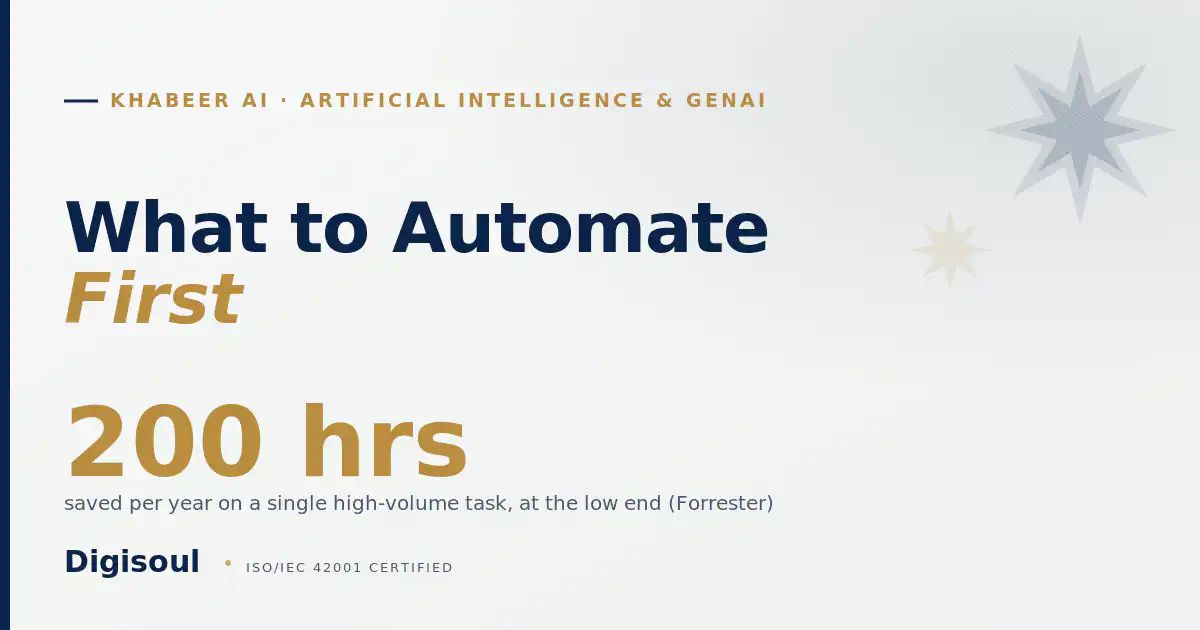
The best first automations are boring on purpose. They are repetitive, governed by explicit rules, and run on data you already trust. Forrester case data shows a single high-volume task such as data entry or invoicing can return around 200 hours a year at the low end, and much more at scale. The aggregate picture is just as strong: teams adopting AI report it returning an average of 21 hours a week, with 75% seeing fewer errors (BILL, 2026).
saved per year on a single high-volume task such as data entry or invoicing, at the low end
saved per week on average by teams adopting AI, with 75% reporting fewer errors
Strong first candidates#
These six show up on almost every list, because they share the same shape.
Strong first candidates
Invoice processing, data entry, reconciliation, report generation, onboarding, and ticket triage are all high-volume and rules-based, which makes them fast to automate and easy to govern. Pick the one or two with the highest volume and the clearest rules in your organization.
The candidate test#
When a task is not on the list, test it.
The candidate test
A good first candidate is high-volume, rules-based, runs on trusted inputs, and is error-prone today. A poor one is low-volume, judgment-heavy, runs on messy inputs, and is rarely run. Automate the left column first; leave the right column until you have proof and controls in place. Then make the case with numbers, see How to Build the Business Case for Automation.
How Khabeer helps#
Khabeer’s Artificial Intelligence and GenAI practice helps you find the right first automations and build them under governance, independent and vendor-neutral, so the work comes off your team’s desk and stays reliable. The first step is a short conversation about the repetitive work draining your team today.
Key takeaways
- Automate high-volume, rules-based, error-prone tasks with trusted inputs first.
- Strong candidates: invoicing, data entry, reconciliation, reporting, onboarding, triage.
- A single high-volume task can return hundreds of hours a year.
- Avoid low-volume, judgment-heavy, messy-input work as a first automation.
Questions, answered
What should we automate first?
How much time can automation save?
How do we know if a task is a good candidate?
Does automating back-office work reduce errors, not just save time?
Should we automate everything at once?
Dr. Ahmed El-Shamy
Co-founder, CEO and Dean of Education, Digisoul
Dr. Ahmed El-Shamy is Co-founder, CEO and Dean of Education at Digisoul. He has more than a decade across AI, fraud risk, and FP&A, and teaches Practical GenAI in FP&A bilingually across MENA, the GCC, and Africa, governed by Digisoul's ISO/IEC 42001:2023-certified AI Management System. Read the leadership profile.
Sources
- Forrester, via Blue Prism: high-volume tasks such as data entry or invoicing can save around 200 hours per year. https://www.blueprism.com/automation-journey/calculate-rpa-roi/
- BILL: 2026 State of AI in Finance (AI saves ~21 hours/week; 75% report fewer errors). https://www.bill.com/blog/state-of-ai-finance-report-takeaways
AI Agent · Built on Claude · Operated on Zoho One