
Key answer
Keep the AI run in-house when you have the team and capacity to monitor, retrain, and support it. Use a managed service when you lack run capacity, need reliability and a clear support path, or want your own talent building rather than babysitting. Many organizations run a hybrid: own the strategy, outsource the run.
The decision to run your AI in-house or hand it to a managed service is not about capability, it is about capacity and focus. Keep the run in-house when you have a team with room to monitor, retrain, and support it. Use a managed service when capacity is thin, reliability is critical, or you want your own talent building rather than babysitting. Many organizations land on a hybrid: own the strategy, outsource the run.
Reaching production is only half the job#
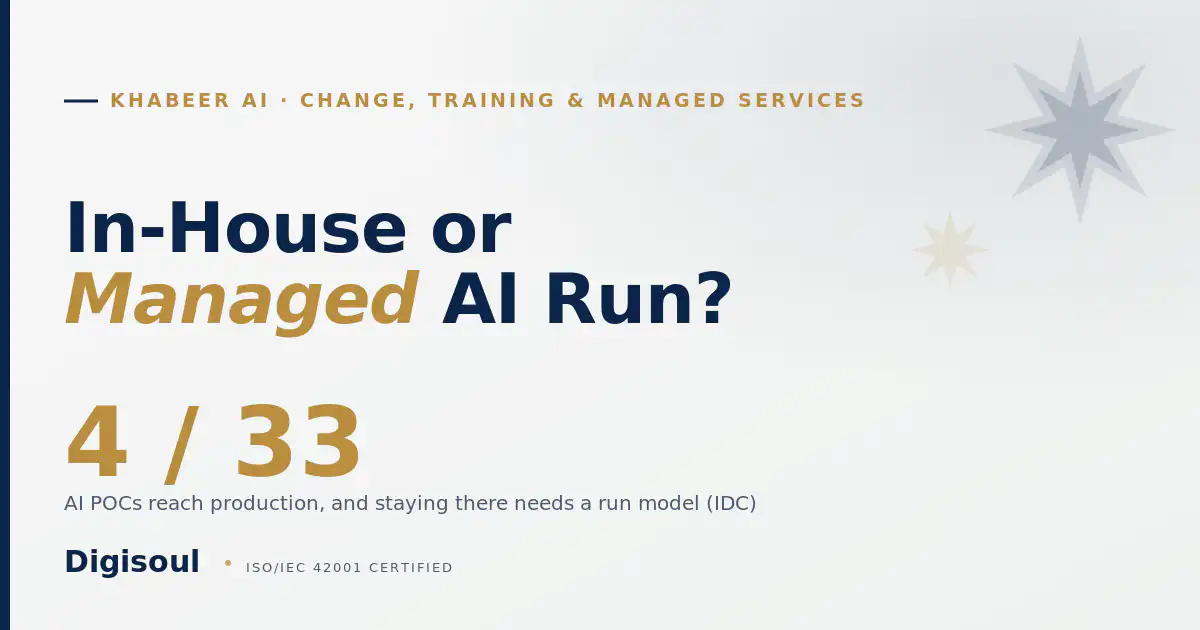
Getting an AI use case live is the milestone everyone celebrates. Keeping it live is the part that quietly fails. Models drift, data changes, and without someone accountable to monitor and retrain, a production capability degrades. IDC found that only about 4 of every 33 AI proofs-of-concept reach production, and staying there needs a deliberate run model.
AI proofs-of-concept reach production, and staying in production needs an owned run model
How you source the capability changes the odds. MIT’s Project NANDA found that enterprise AI tools bought from or partnered with specialist vendors reach successful deployment about 67% of the time, while internal builds succeed only one-third as often. A managed service, or a hybrid that pairs your strategy with an external run, is one way to put your capability on the higher-success side of that line and keep it there.
Buy or partner beats build, by a wide margin
In-house run vs managed run#
The two models trade control against capacity.
In-house run vs managed run
An in-house run gives you full day-to-day control but needs spare capacity and a strong team. A managed run includes monitoring, support, and a clear SLA, frees your team to build, and suits organizations whose capacity is thin. Neither is better in the abstract; the right one depends on your team.
Choose X when#
Choose X when
Keep it in-house when you have the team and the capacity. Go managed when capacity is thin or reliability is critical. Run a hybrid when you want to own the strategy and direction while outsourcing the day-to-day run, which is the most common answer for growing organizations. Whichever you choose, adoption still has to be handled, see the adoption playbook.
How Khabeer helps#
Khabeer offers managed application and platform services with monitoring, support, optimization, and a governed improvement cadence, independent and vendor-neutral, and always on your ownership with no lock-in. The first step is a short conversation about what you have in production and who is keeping it reliable.
Key takeaways
- Keep the run in-house when you have the team and capacity to monitor and retrain.
- Outsource the run when capacity is thin, reliability is critical, or you want talent building.
- A hybrid, own the strategy and outsource the run, is common and sensible.
- Reaching production is not enough; staying there needs an owned run model.
Questions, answered
What is a managed AI service?
When should we keep the AI run in-house?
When should we outsource it?
Is it better to buy or build enterprise AI?
Do we lose ownership if we outsource?
Dr. Ahmed El-Shamy
Co-founder, CEO and Dean of Education, Digisoul
Dr. Ahmed El-Shamy is Co-founder, CEO and Dean of Education at Digisoul. He has more than a decade across AI, fraud risk, and FP&A, and teaches Practical GenAI in FP&A bilingually across MENA, the GCC, and Africa, governed by Digisoul's ISO/IEC 42001:2023-certified AI Management System. Read the leadership profile.
Sources
- IDC (Lenovo CIO Playbook 2025), via CIO: about 4 of every 33 AI POCs reach production. https://www.cio.com/article/3850763/88-of-ai-pilots-fail-to-reach-production-but-thats-not-all-on-it/
- MIT NANDA, The GenAI Divide: State of AI in Business (2025): vendor-bought or partnered AI tools reach deployment ~67% of the time, versus internal builds, which succeed only one-third as often. https://nanda.media.mit.edu/
AI Agent · Built on Claude · Operated on Zoho One