
Key answer
AI tools go unused because adoption is a behavior problem, not a licensing one. People do not use AI that has no clear place in their daily job, no training, no trust, and no incentive. The fix is a change playbook: lead from the front, train on real work, embed AI in the workflow, and measure adoption, not seats bought.
AI tools go unused for a reason that has nothing to do with the tools. Adoption is a behavior problem, not a licensing one. People do not use AI that has no clear place in their daily job, that they were never trained on, whose output they do not trust, and that nothing rewards them for using. Buy the best platform on the market and, without those four things, it will sit idle.
Bought is not adopted#
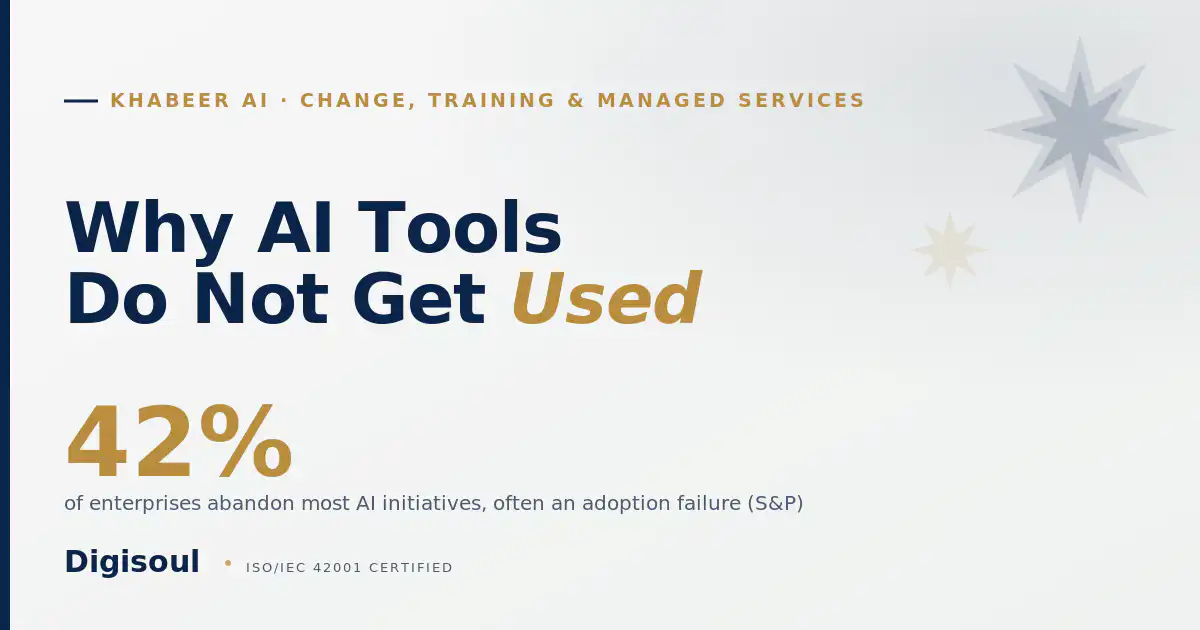
The most expensive AI failure is not a pilot that breaks. It is a tool the whole company is paying for and nobody opens. It looks like success on the invoice and failure on the floor. The market shows how common abandonment is: the share of enterprises walking away from most of their AI initiatives rose to 42% in 2025, up from 17%, and a large part of that is adoption, not technology. We have written before about the AI at work adoption gap.
of enterprises abandon most AI initiatives, frequently an adoption failure, not a technology one
The deeper gap is value, not access. McKinsey found 88% of organisations use AI but only about 6% are high performers capturing real EBIT impact, and those winners are nearly three times as likely to have fundamentally redesigned their workflows (55% versus around 18%). Adoption is exactly that rewiring of how the work gets done, not the purchase order.
Adoption, not access, is the gap
Why adoption stalls#
Name the barriers and they become fixable.
Why adoption stalls
The tool has no place in the job people already do. There was a demo but no training on real work. People do not trust output they cannot check. And nothing rewards them for changing how they work. Each barrier alone suppresses usage; together they guarantee a quiet abandonment.
The adoption playbook#
Adoption is led and measured, not announced in an email.
The adoption playbook
Leaders use the tools visibly, so it is clearly how the organization now works. Training happens on people’s real, current tasks, not a generic course. AI is embedded into the existing workflow rather than bolted beside it. And you measure actual usage and outcomes, then close the gaps. That loop is what turns a purchase into a habit.
How Khabeer helps#
Khabeer’s Change, Training and Managed Services practice covers adoption, skills, and a managed run, independent and vendor-neutral, so the tools you have bought get used and stay used. For the skills half of the problem, see Closing the AI Skills Gap on Your Team. The first step is a short conversation about which tools are going unused and why.
Key takeaways
- Adoption is a behavior problem: place in the job, training, trust, and incentive.
- Buying seats is not adoption; usage and outcomes are.
- Lead from the front, train on real work, embed in the workflow, and measure.
- Most AI that is abandoned was never adopted, not because the tool was bad.
Questions, answered
Why is nobody using the AI tools we bought?
How do we drive AI adoption?
What percentage of AI projects fail or get abandoned?
How do we measure adoption?
Is this training or change management?
Dr. Ahmed El-Shamy
Co-founder, CEO and Dean of Education, Digisoul
Dr. Ahmed El-Shamy is Co-founder, CEO and Dean of Education at Digisoul. He has more than a decade across AI, fraud risk, and FP&A, and teaches Practical GenAI in FP&A bilingually across MENA, the GCC, and Africa, governed by Digisoul's ISO/IEC 42001:2023-certified AI Management System. Read the leadership profile.
Sources
- S&P Global Market Intelligence: GenAI rapid growth, mixed results (42% abandoned most AI, up from 17%) (Oct 2025). https://www.spglobal.com/market-intelligence/en/news-insights/research/2025/10/generative-ai-shows-rapid-growth-but-yields-mixed-results
- McKinsey: The State of AI 2025 (88% use AI; ~6% high performers; high performers ~3x more likely to redesign workflows). https://www.mckinsey.com/capabilities/quantumblack/our-insights/the-state-of-ai
- Digisoul: The AI at Work Adoption Gap. https://digisoul.io/the-ai-at-work-adoption-gap-2/
AI Agent · Built on Claude · Operated on Zoho One