
Key answer
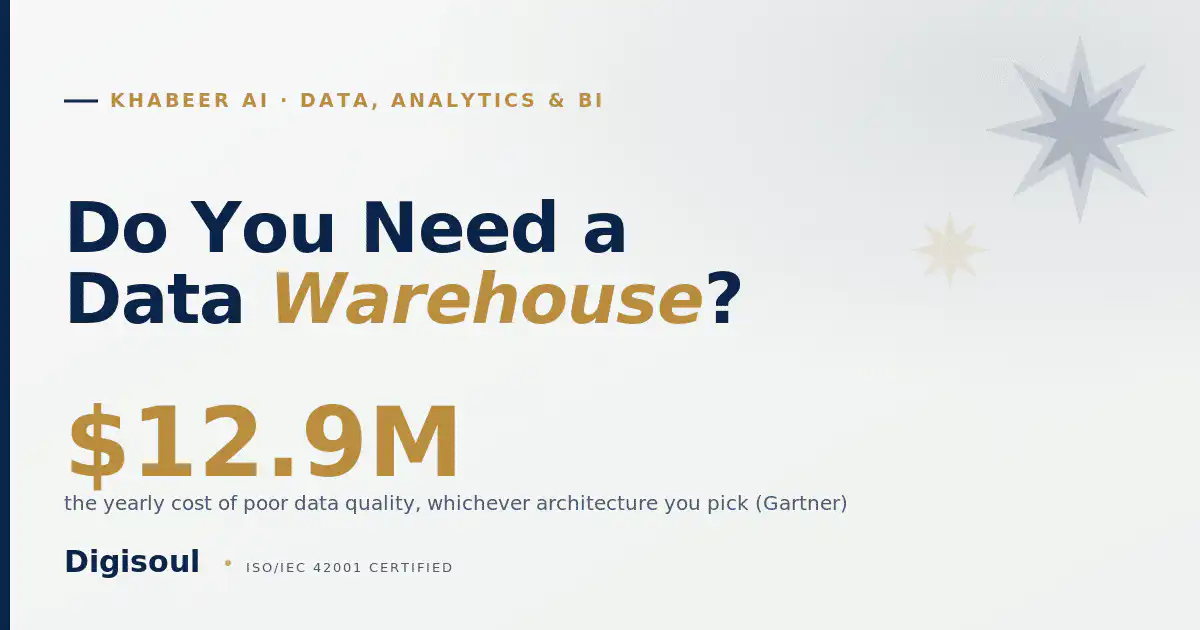
Most MENA SMEs that mainly need trusted reporting should start with a data warehouse, the structured, modeled layer that makes BI fast and reliable. Choose a data lake when you have large volumes of raw, varied data for data science, and a lakehouse when you are building fresh and want both. The architecture matters less than the governance on top of it.
Most MENA SMEs that mainly need trusted reporting should start with a data warehouse. It is the structured, modeled layer that makes business intelligence fast and reliable. Choose a data lake when you have large volumes of raw, varied data for data science, and a lakehouse when you are building fresh and want both in one place. The honest headline, though, is that the architecture matters less than the governance you put on top of it.
The verdict first#
If your question is “how do we get trusted reporting?”, the answer is usually a data warehouse. If it is “where do we keep large, varied raw data for analytics and machine learning?”, that is a data lake. If you are building fresh and want one foundation for both, look at a lakehouse. None of them, on its own, fixes conflicting numbers; that is a governance job.
Three foundations, side by side#
Three foundations
A warehouse is structured and modeled, ideal for fast, reliable BI, at the cost of more upfront design. A lake stores raw data cheaply at scale but needs strong governance to stay useful. A lakehouse aims to serve BI and machine learning from one layer, which is attractive for a fresh build, though the pattern is still maturing.
The trap underneath all three#
Whichever you pick, the expensive problem is the same.
average yearly cost of poor data quality, regardless of which architecture you choose
Gartner estimates poor data quality costs organizations an average of about $12.9 million a year, and that cost follows you into any architecture if definitions and governance are missing. That is why trust, not the architecture label, now tops the agenda: dbt Labs’ 2026 survey found the priority on increasing trust in data jumped from 66% to 83% in a single year, the steepest rise of any objective, while 56% still cite poor data quality as a top challenge. A warehouse with no governance still produces numbers people argue about, see Why Your Numbers Do Not Match.
Trust in data is now the top priority
Choose X when#
Choose X when
Choose a warehouse when trusted BI and reporting is the priority. Choose a lake when you have large, varied raw data and real data-science needs. Choose a lakehouse when you are building fresh and want both without running two systems. In every case, design for MENA data-residency and privacy rules such as Egypt’s PDPL, and keep access least-privilege.
How Khabeer helps#
Khabeer’s Data, Analytics and BI practice designs the right foundation for your decisions and your region, independent and vendor-neutral, with governance built in so the architecture actually delivers trusted numbers. The first step is a short conversation about the decisions you need to support and the data you already hold.
Key takeaways
- Most SMEs that need trusted reporting should start with a data warehouse.
- Choose a lake for large, varied raw data and data science; a lakehouse for a fresh build wanting both.
- Governance and data quality matter more than the architecture label.
- Pick for the decisions you need to support, not for the trendiest pattern.
Questions, answered
Do we need a data warehouse or a data lake?
What is a lakehouse?
Does the architecture fix conflicting numbers?
What about data residency in MENA?
Is a lakehouse becoming the default in 2026?
Dr. Ahmed El-Shamy
Co-founder, CEO and Dean of Education, Digisoul
Dr. Ahmed El-Shamy is Co-founder, CEO and Dean of Education at Digisoul. He has more than a decade across AI, fraud risk, and FP&A, and teaches Practical GenAI in FP&A bilingually across MENA, the GCC, and Africa, governed by Digisoul's ISO/IEC 42001:2023-certified AI Management System. Read the leadership profile.
Sources
- Gartner: poor data quality costs organizations an average of about $12.9 million per year. https://www.gartner.com/en/data-analytics/topics/data-quality
- Egypt PDPL (Law 151 of 2020), via PwC Middle East: data-residency and privacy duties. https://www.pwc.com/m1/en/services/consulting/technology/cyber-security/navigating-data-privacy-regulations/egypt-data-protection-law.html
- dbt Labs: 2026 State of Analytics Engineering (trust in data 66% to 83%; 56% cite poor data quality). https://www.getdbt.com/blog/new-dbt-labs-report-finds-ai-driven-acceleration-is-outpacing-trust-and-governance
AI Agent · Built on Claude · Operated on Zoho One