
Key answer
An AI maturity assessment scores your organization across five dimensions: data, technology, process, people and culture, and governance. It tells you where you are ready to deploy AI and where readiness must come first. The point is to invest where the foundation can support production, not where a tool looked impressive.
An AI maturity assessment scores your organization across five dimensions, data, technology, process, people and culture, and governance, and tells you where you are ready to deploy AI and where readiness has to come first. It is the diagnosis that belongs before any platform, model, or automation decision. Skip it, and you invest where a tool looked impressive rather than where the foundation can actually carry it.
Most stalled AI is a readiness problem#
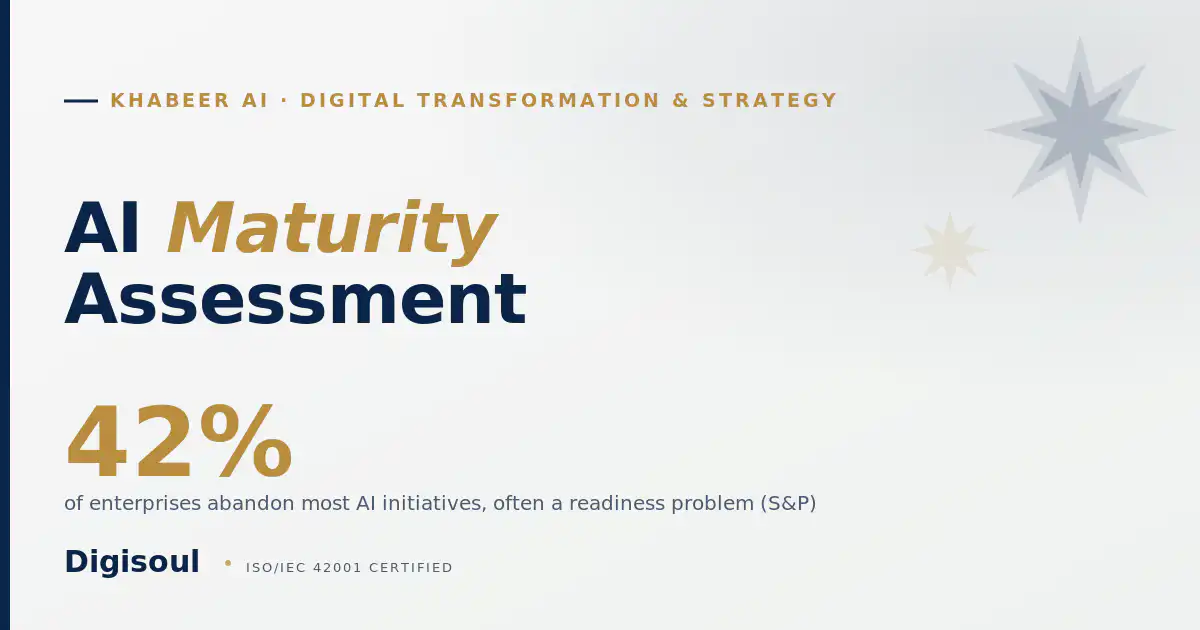
When AI does not reach production, the instinct is to blame the model. The real cause is usually underneath it: ungoverned data, no owner, a process AI cannot plug into, or controls the audit committee will not accept. S&P found the share of enterprises abandoning most of their AI initiatives rose to 42% in 2025, up from 17%, and readiness gaps are a major reason. The deeper gap is value: McKinsey found 88% of organisations use AI but only about 6% capture real EBIT impact, and just 21% have redesigned any workflow, the readiness work a maturity baseline surfaces before you spend.
of enterprises abandon most AI initiatives, up from 17%, often a readiness gap
Readiness, not the model, is the gap
Five dimensions of readiness#
A baseline scores each dimension, so you see the foundation clearly before spending.
Five dimensions of readiness
Data covers quality, access, and ownership. Technology covers platforms, integration, and the ability to run models. Process covers the workflows AI can plug into. People and culture covers skills and the appetite to change how work is done. Governance covers controls, oversight, and audit-ready accountability. A weak score in any one is where a deployment will fail.
What low and high maturity look like#
The baseline makes the gap concrete.
Low vs high maturity
Low-maturity organizations run tool-led experiments on ungoverned data with no owners, and their pilots stall. High-maturity organizations run a value-led roadmap on trusted, governed data with clear owners, and their use cases reach production. The assessment shows you which you are, dimension by dimension.
How Khabeer helps#
Khabeer runs a five-dimension readiness baseline as the first step of its Digital Transformation and Strategy practice, independent and vendor-neutral, producing a scorecard, a use-case prioritization matrix, and a readiness map. Use it to sequence a costed AI roadmap so investment follows readiness. The starting point is a short conversation about where you think you are and where you want to deploy.
Key takeaways
- Score readiness across data, technology, process, people, and governance before investing.
- Most stalled AI is a readiness problem, not a model problem.
- A baseline shows where to deploy now and where to build the foundation first.
- Use the score to sequence a roadmap, not to justify a tool already bought.
Questions, answered
What is an AI maturity assessment?
Why does maturity matter more than the model?
What do we do with the score?
What share of organisations actually reach AI value?
How long does an assessment take?
Dr. Ahmed El-Shamy
Co-founder, CEO and Dean of Education, Digisoul
Dr. Ahmed El-Shamy is Co-founder, CEO and Dean of Education at Digisoul. He has more than a decade across AI, fraud risk, and FP&A, and teaches Practical GenAI in FP&A bilingually across MENA, the GCC, and Africa, governed by Digisoul's ISO/IEC 42001:2023-certified AI Management System. Read the leadership profile.
Sources
- S&P Global Market Intelligence: GenAI rapid growth, mixed results (42% abandoned most AI, up from 17%) (Oct 2025). https://www.spglobal.com/market-intelligence/en/news-insights/research/2025/10/generative-ai-shows-rapid-growth-but-yields-mixed-results
- McKinsey: The State of AI 2025 (88% use AI; ~6% high performers; 21% have redesigned a workflow). https://www.mckinsey.com/capabilities/quantumblack/our-insights/the-state-of-ai
- IDC (Lenovo CIO Playbook 2025), via CIO: about 4 of every 33 AI POCs reach production, a readiness gap. https://www.cio.com/article/3850763/88-of-ai-pilots-fail-to-reach-production-but-thats-not-all-on-it/
AI Agent · Built on Claude · Operated on Zoho One