
Key answer
AI pilots stall before production because the demo was never the hard part. The hard part is production-ready data, a named owner, governance the audit committee accepts, and a use case tied to real value. The fix is to run one governed lifecycle, assess, prioritize, build, govern, operate, instead of funding more disconnected demos.
AI pilots stall before production because the demo was never the hard part. A model that drafts a summary or answers a question in a meeting looks impressive, but a live decision needs reliable data, controls, an owner, and a value case the board can see. When those are missing, the pilot dies between the demo and the floor. This is the most common, and most fixable, pattern in enterprise AI today.
The pilots impress, then never reach the floor#
You have funded a wave of GenAI and agentic experiments. Each demo looked promising. Yet none has reached a live decision, leadership cannot say which to fund next, and the audit committee keeps asking why it should approve a go-live it cannot trace. You are not behind. You are exactly where most organizations are.
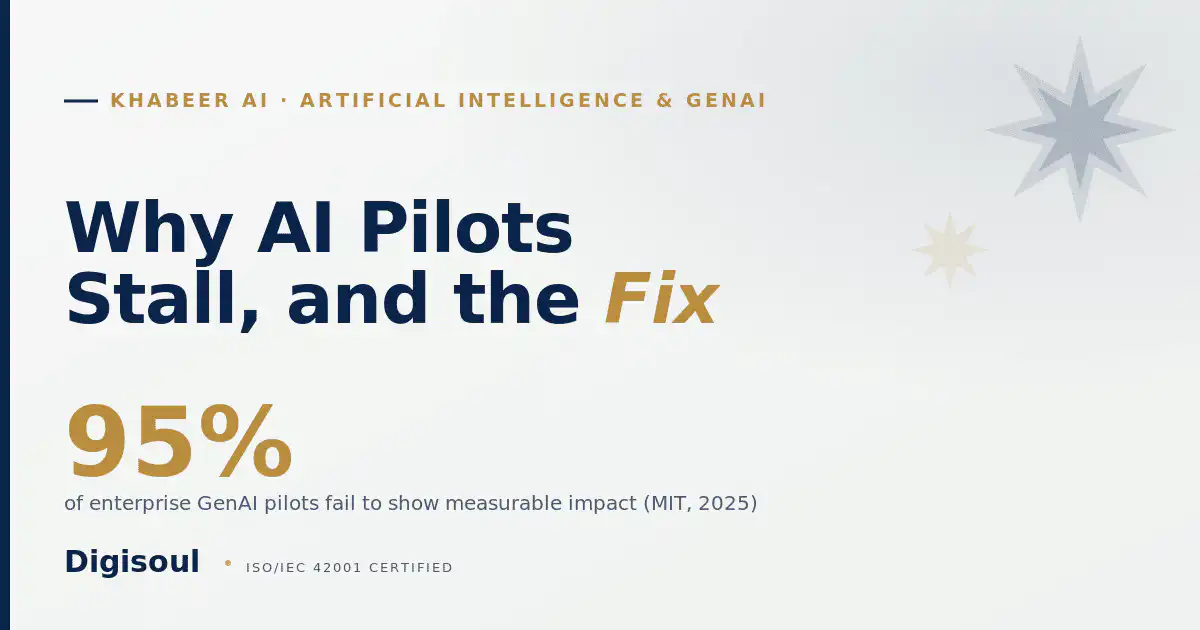
of enterprise GenAI pilots fail to deliver measurable P&L impact
The numbers are blunt. MIT’s 2025 research found that about 95% of enterprise generative-AI pilots fail to deliver measurable P&L impact, and IDC reports that for every 33 AI proofs-of-concept, only about 4 reach production. The share of enterprises abandoning most of their AI work jumped from 17% to 42% in a single year, and the average organisation scrapped 46% of its proofs-of-concept before production. Gartner expects at least 30% of GenAI projects to be abandoned after proof of concept for the same reasons: poor data, weak controls, unclear value.
Why AI pilots stall before production#
The causes are rarely about the model. They are about everything around it.
Why pilots stall
The data that fed the demo was a clean sample; the real data is messy and ungoverned. No one is accountable to run the thing after launch, so it has no operating model. The audit committee cannot approve what it cannot trace, so there is a governance gap. And too often the use case impressed without changing a decision worth money. Fix those four and the model is the easy part.
The fix: one governed lifecycle#
The answer is not another pilot. It is to take one or two high-value use cases all the way around a single governed loop, with governance at the center rather than bolted on at the end.
One governed lifecycle
You assess readiness across data, skills, and risk; prioritize the use cases worth backing into a sequenced business case; build and validate the models and agents with human review wired in; set the governance and audit trail; then stand up an operating model your team owns, with monitoring and retraining triggers. One accountable partner across the loop beats stitching readiness, build, and governance from separate vendors. The build-or-buy call matters too: MIT found bought or partnered tools reach production about three times as often as internal builds, 67% versus roughly 22%, which a vendor-neutral advisor weighs per use case.
Buy beats build on production success
What this looks like with Khabeer#
Khabeer AI is independent, vendor-neutral, MENA-native advisory that moves stalled pilots to governed production. In one illustrative example (hypothetical, sector-specific, not a real client), a large services organization with many pilots retires the ones that cannot earn their keep, moves two sequenced use cases into governed production, and runs them on an operating model its own team owns, monitoring drift and retraining without waiting on outside help. The work is aligned to SDAIA expectations and informed by Digisoul’s ISO/IEC 42001:2023-certified AI Management System, with no lock-in.
If your pilots impress in the demo and then stall, the next step is not a bigger demo. It is a short, focused conversation about the decisions you want AI to change and what the board needs to approve a go-live.
Key takeaways
- The demo is the easy part; production needs data, an owner, governance, and tangible value.
- Most enterprise GenAI pilots fail to show measurable impact, so funding more demos is not the answer.
- Run one governed lifecycle, assess, prioritize, build, govern, operate, not disconnected experiments.
- Independent and vendor-neutral matters: the advice should serve your outcome, not a platform's roadmap.
Questions, answered
What percentage of AI pilots actually reach production?
What share of AI proofs-of-concept get scrapped before production?
Why does my pilot work in the demo but not in production?
How do we get a stalled pilot to production?
Do we need to replace our current AI tools?
Dr. Ahmed El-Shamy
Co-founder, CEO and Dean of Education, Digisoul
Dr. Ahmed El-Shamy is Co-founder, CEO and Dean of Education at Digisoul. He has more than a decade across AI, fraud risk, and FP&A, and teaches Practical GenAI in FP&A bilingually across MENA, the GCC, and Africa, governed by Digisoul's ISO/IEC 42001:2023-certified AI Management System. Read the leadership profile.
Sources
- MIT (NANDA), State of AI in Business 2025, via Fortune: ~95% of enterprise GenAI pilots fail to deliver measurable impact. https://fortune.com/2025/08/18/mit-report-95-percent-generative-ai-pilots-at-companies-failing-cfo/
- IDC (Lenovo CIO Playbook 2025), via CIO: about 4 of every 33 AI POCs reach production. https://www.cio.com/article/3850763/88-of-ai-pilots-fail-to-reach-production-but-thats-not-all-on-it/
- S&P Global Market Intelligence: GenAI rapid growth, mixed results (42% abandoned most AI, up from 17%; 46% of PoCs scrapped) (Oct 2025). https://www.spglobal.com/market-intelligence/en/news-insights/research/2025/10/generative-ai-shows-rapid-growth-but-yields-mixed-results
- MIT Project NANDA: State of AI in Business 2025 (bought/partnered tools ~67% reach production vs ~22% internal builds). https://mlq.ai/media/quarterly_decks/v0.1_State_of_AI_in_Business_2025_Report.pdf
- Gartner: 30% of GenAI projects abandoned after proof of concept by end-2025 (Jul 2024). https://www.gartner.com/en/newsroom/press-releases/2024-07-29-gartner-predicts-30-percent-of-generative-ai-projects-will-be-abandoned-after-proof-of-concept-by-end-of-2025
AI Agent · Built on Claude · Operated on Zoho One