
Key answer
GenAI in FP&A is the use of generative AI to draft, explain, and pressure-test financial planning and analysis work: variance commentary, driver-based forecasts, scenario models, and reporting. In 2026 the value is not novelty, it is governed time-back: AI handles the first draft and the data wrangling, while finance keeps judgement, review, and the audit trail.
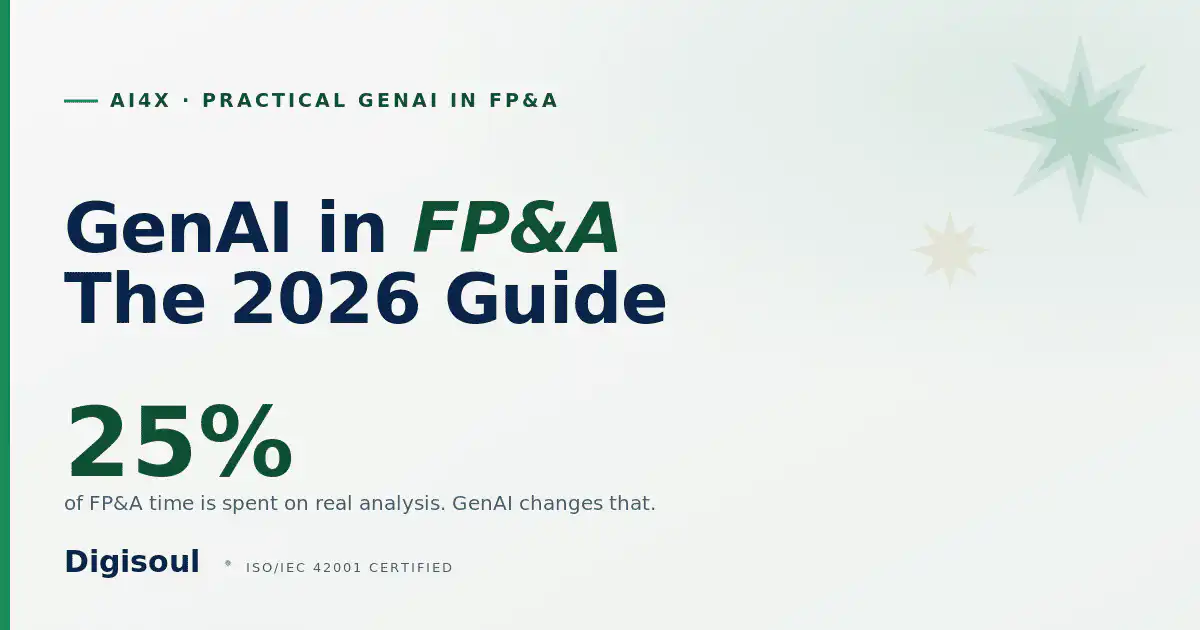
Finance teams do not have a generative AI problem. They have a time problem that GenAI can finally fix. Across recent FP&A benchmarks, analysts report spending only about a quarter of their time on real analysis, with the rest lost to gathering data and running process (Vena, reporting AFP and APQC). The 2025 FP&A Trends benchmark puts roughly 46% of FP&A time on data collection and validation alone. That is the gap GenAI closes, if you adopt it in a governed way.
This guide is the hub for everything Digisoul publishes on GenAI in FP&A. It defines the term, shows the operating model, walks the four workflows where GenAI earns its keep, and links to the deep-dive articles for each. It is written for mid-to-senior FP&A operators, finance business partners, controllers, and CFOs-in-waiting across MENA who already know finance and want AI fluency they can ship.
What is GenAI in FP&A?#
GenAI in FP&A is the use of generative AI to draft, explain, and pressure-test financial planning and analysis work. In practice that means three things: the model writes a first draft (variance commentary, a forecast narrative, a board paragraph), it helps wrangle and reconcile the data that feeds the model, and it lets you interrogate numbers in plain language. The analyst stays in control, reviewing every output, correcting it, and signing it off.
It helps to separate GenAI from the AI finance has used for years. Statistical forecasting and machine learning predict a number. Robotic process automation moves data between systems. Generative AI produces language, structure, and explanation on top of those numbers. The three are complementary, and a mature FP&A function uses all three. For the full definition, the boundary with autonomous finance, and six concrete use cases, read What Is GenAI in FP&A?.
Why GenAI in FP&A matters now#
The shift is no longer speculative. Gartner predicts that embedded AI in cloud ERP applications will drive a 30% faster financial close by 2028, and that by 2027, 90% of descriptive and diagnostic analytics in finance will be fully automated. The strategic upside is just as clear: Gartner expects that by 2029, CFOs who deploy AI strategically will add 10 margin points of growth versus those who do not.
Read that carefully. The automation lands on the low-judgement work: data collection, reconciliation, descriptive and diagnostic reporting. The premium moves to judgement, framing, and decision support. GenAI is the lever that moves your team from the first category to the second.
Adoption is wide, value is not yet#
The honest counterpoint is that most finance functions have not turned adoption into impact. Gartner found that 84% of finance organisations have implemented or plan to implement AI, yet only 7% report high or very high impact from it (Gartner, June 2026). Adoption itself has plateaued: finance AI use sat at 59% in 2025, barely up from 58% in 2024 after the jump from 37% in 2023.
Wide adoption, thin value
The gap is not the tooling, it is method. Teams chase isolated pilots instead of governing AI as a portfolio of workflows. That is exactly why a sequenced, workflow-by-workflow rollout under clear controls outperforms a big-bang launch, and it is the thesis the rest of this guide builds out.
The 5-tier FP&A AI-maturity model#
Most teams try to leap straight to autonomous agents and stall. A maturity curve is more honest. Digisoul teaches a five-tier model that lets you place your function today and pick the next realistic step.
- Manual. Spreadsheets and copy-paste. AI is a side experiment that never sticks.
- Assisted. Analysts prompt ChatGPT or Copilot ad hoc. Useful, but unreproducible and ungoverned.
- Standardised. A shared prompt library and templates. The same task gives the same quality every time.
- Integrated. AI is wired into the close-to-forecast-to-report cycle with human checkpoints and a logged audit trail.
- Governed agents. Hub-and-spoke agent workflows handle routine cascades end to end, with humans approving at defined gates.
FP&A AI-maturity, five tiers
Tier 1, Manual: spreadsheets and copy-paste, no AI in the loop.
The goal is not to reach tier five everywhere. It is to move each workflow up one tier with the controls in place. That sequencing is the heart of the GenAI FP&A operating model.
The four FP&A workflows GenAI changes first#
GenAI does not transform FP&A all at once. It transforms four workflows, in this order.
Where GenAI lands first
1. Variance analysis and commentary
This is the fastest win, and the data agrees. Gartner found that 66% of finance leaders expect generative AI’s most immediate impact to be explaining forecast and budget variances. AI drafts the “what moved and why” narrative from your actuals; you verify and sign off. See the step-by-step method in How to Run Variance Analysis with AI.
2. Forecasting and driver-based models
GenAI helps you build driver trees, document assumptions, and explain a Monte Carlo or DCF output in words a board will read. Whether to lead with AI forecasting or keep the annual budget is a real decision, covered in AI Forecasting vs Traditional Budgeting.
3. Scenario and strategic planning
Instead of one base case, you plan in weighted scenarios and let AI stress-test the logic and surface the drivers that matter. The operating model article shows where this sits in the cycle.
4. Reporting, dashboards, and KPI automation
GenAI turns reporting into dashboards people act on, with RAG alerts (here RAG means Red, Amber, Green status, not retrieval-augmented generation) and automated refresh. This is where descriptive reporting quietly becomes self-serving.
How to govern GenAI in FP&A#
Governance is not the brake on this work, it is what makes it shippable. Finance data is sensitive, and in Egypt and across MENA it is treated as sensitive personal data under data-protection law. A credible programme bakes in four controls: enterprise tools with data-protection terms, a human reviewer on every output, a logged audit trail, and an AI management system aligned to a recognised standard. Digisoul governs its own work under an ISO/IEC 42001:2023-certified AI Management System. The full control set for MENA finance teams is in GenAI for FP&A in MENA: Data, Governance, Adoption.
A 90-day rollout, not a big-bang rebuild#
You do not need a transformation programme to start. You need one workflow, governed, in production, then the next. A simple 90-day arc works:
- Days 1 to 30: stand up a governed variance workflow. Pick one entity, draft commentary with AI, add the audit log, get it signed off.
- Days 31 to 60: add a driver-based forecast and a scenario model on your own numbers.
- Days 61 to 90: wire an executive dashboard with RAG alerts and automate the KPI refresh, then write the adoption plan for the wider team.
A governed 90-day rollout
This is the spine of the PACE rollout taught in the programme, and it is what turns interest into something you can defend to a CFO.
What you need to start#
You do not need a data-science team. You need Excel fluency, solid FP&A fundamentals (close, variance, forecasting), access to enterprise AI tooling such as Microsoft 365 with Copilot, a real organisation to apply the work to, and a governance posture you can point to. Everything else is learnable in weeks, not years. For the wider context on why adoption stalls even when the tools are in place, see The AI at Work Adoption Gap.
GenAI will not hand your team a strategy. Used in a governed way, it hands your team its time back, and time is the raw material of good analysis.
Key takeaways
- GenAI in FP&A means AI drafts and explains the work; finance keeps judgement, review, and the audit trail.
- The 2026 payoff is governed time-back, not novelty: less data wrangling, faster variance and forecasting, more analysis.
- Move up a five-tier maturity curve, from assisted prompting to governed agent workflows, one workflow at a time.
- Govern it from day one: ISO/IEC 42001 controls, human-in-the-loop sign-off, and a logged audit trail on every output.
- A defendable 90-day rollout beats a big-bang rebuild. Start with variance, then forecasting, then dashboards.
Questions, answered
What is GenAI in FP&A in simple terms?
Will GenAI replace FP&A analysts?
Why do most finance AI projects fail to deliver value?
Is GenAI safe to use on confidential financial data?
Do I need to know how to code to use GenAI in FP&A?
How much does the Practical GenAI in FP&A programme cost?
Dr. Ahmed El-Shamy
Co-founder, CEO and Dean of Education, Digisoul
Dr. Ahmed El-Shamy is Co-founder, CEO and Dean of Education at Digisoul. He has more than a decade across AI, fraud risk, and FP&A, and teaches Practical GenAI in FP&A bilingually across MENA, the GCC, and Africa, governed by Digisoul's ISO/IEC 42001:2023-certified AI Management System. Read the leadership profile.
Sources
- Gartner · Embedded AI in cloud ERP to drive a 30% faster financial close by 2028 (Feb 2026). https://www.gartner.com/en/newsroom/press-releases/2026-02-24-gartner-predicts-embedded-ai-in-cloud-erp-applications-will-drive-a-30-percent-faster-financial-close-by-2028
- Gartner · CFOs with strategic AI deployment to add 10 margin points of growth by 2029 (Apr 2026). https://www.gartner.com/en/newsroom/press-releases/2026-04-28-gartnerpredicts-by-2029-cfos-who-implement-strategic-ai-deploymnt-will-add-10-margin-points-of-growth
- Gartner · Autonomous finance predictions (90% of descriptive/diagnostic analytics automated by 2027). https://www.gartner.com/en/finance/trends/autonomous-finance-predictions
- Vena (reporting AFP and APQC) · FP&A teams spend ~25% of time on value-added analysis. https://www.venasolutions.com/blog/time-spent-on-analysis
- FP&A Trends 2025 Benchmarks · 46% of FP&A time still spent on data collection and validation. https://fpa-trends.com/article/2025-fpa-benchmarks-and-trends
- Gartner · CFOs need structured finance AI roadmaps (84% adopting, 7% high impact) (Jun 2026). https://www.gartner.com/en/newsroom/press-releases/2026-06-08-gartner-says-cfos-need-structured-finance-ai-roadmaps
- Gartner · Finance AI adoption steady in 2025 (59%, up from 58% in 2024 and 37% in 2023) (Nov 2025). https://www.gartner.com/en/newsroom/press-releases/2025-11-18-gartner-survey-shows-finance-ai-adoption-remains-steady-in-2025
AI Agent · Built on Claude · Operated on Zoho One