
Key answer
AI forecasting and traditional budgeting solve different jobs. An annual budget sets a fixed plan and accountability target; an AI-driven rolling forecast continuously predicts where you will land. In 2026 most finance teams should run both: keep a lean budget for control, and use AI rolling forecasts, refreshed monthly on drivers, for decisions. Choose the budget for commitment, the forecast for steering.
AI forecasting and traditional budgeting are not rivals doing the same job badly or well. They do different jobs. A budget is a fixed plan that sets targets and commits resources for the year. An AI-driven rolling forecast is a continuously updated prediction of where you will actually land. The 2026 answer for most finance teams is not “pick one”, it is “run both, deliberately”: keep a lean budget for control and use AI rolling forecasts for steering.
This article gives you the decision, the evidence, and the governance caveat. It builds on the GenAI FP&A operating model; if you are still framing the basics, start with the complete guide.
The verdict first#
Choose the annual budget when you need a hard commitment, accountability, and a resourcing line in the sand. Choose an AI-driven rolling forecast when you need to steer, reallocate, and answer “where will we land?” between budget cycles. Choose the hybrid, which is what we recommend for most MENA finance teams in 2026, when you want both control and agility without doubling the work.
The comparison#
| Dimension | Traditional annual budget | AI-driven rolling forecast |
|---|---|---|
| Primary job | Commit and control | Predict and steer |
| Cadence | Once a year, then static | Monthly or quarterly, always forward |
| Built around | Line items | Operational drivers |
| Effort | High at year-end, then idle | Spread, automated by AI |
| Accuracy intent | Hit the target | Reduce forecast error |
| Main risk | Out of date by Q2 | Garbage in, confident out |
Two jobs, not two rivals
The clearest way to see the difference: a budget commits to a single point, while an AI forecast projects a range. Tap a case below to isolate it.
The budget is a point; the forecast is a range
What the evidence says#
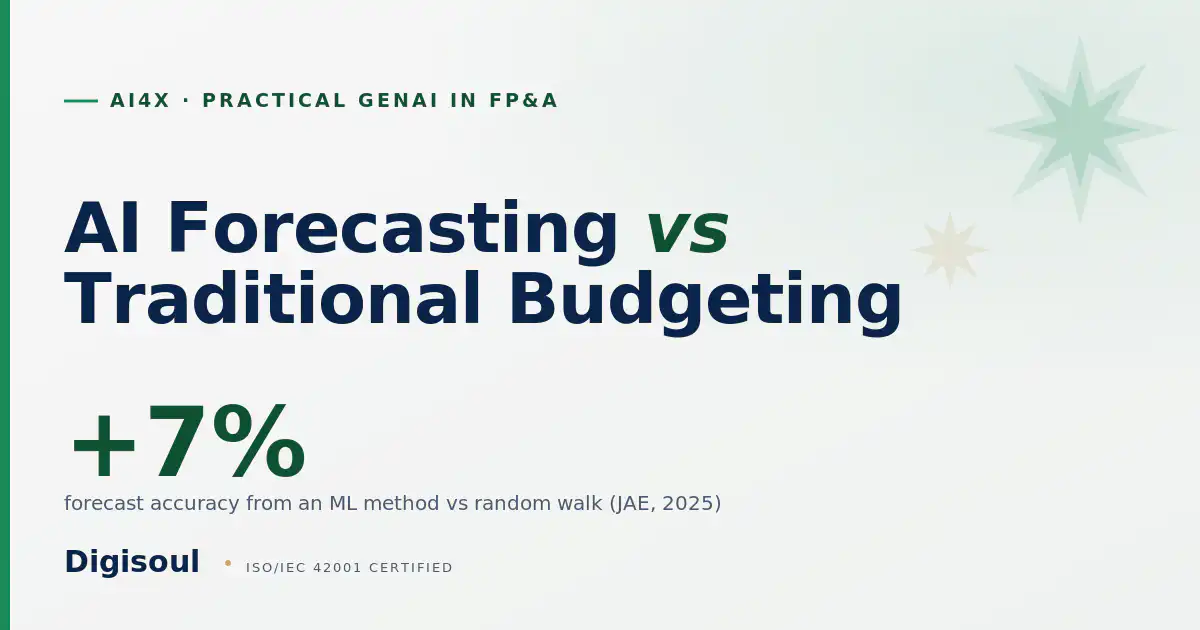
On pure prediction, AI and machine learning have a real, if incremental, edge. A method published in the December 2025 Journal of Accounting and Economics improved earnings-forecast accuracy by about 7% versus the random-walk benchmark. The process shift is bigger than any single model: Gartner predicts that by 2028, 50% of organisations will have replaced time-consuming bottom-up forecasting with AI (a 2023 prediction), enabling more continuous planning.
Two cautions keep this honest. First, “more accurate” compares one forecast with another; it does not make a forecast a substitute for the budget’s role as a commitment. Second, the accuracy gain depends on input data quality and a sound driver model. AI does not rescue a weak data foundation; it just produces a more confident version of it.
forecast-accuracy gain from a machine-learning method versus the random-walk benchmark
Method matters as much as model. In the 2025 FP&A Trends Survey, 77% of teams on fully driver-based models rate their forecasts good or great, against 27% of those with basic or no models, yet only 17% have adopted driver-based planning. Speed is the other gap: 29% of organisations still need more than ten days to produce a forecast, and only 15% can do it in under two, long enough that the number is stale before it lands.
Driver-based forecasts win on quality
When to choose each#
- Keep a (lean) annual budget when you need board-level commitment, covenant or regulatory targets, or clear accountability per owner.
- Lead with an AI rolling forecast when your environment moves faster than the budget cycle, drivers shift mid-year, or leadership keeps asking “where will we land?”
- Run the hybrid when you want both, which is most teams. A single driver-based model feeds the budget as a snapshot and the rolling forecast as a live update, so you are not maintaining two systems.
Choose X when
The governance caveat#
An AI forecast is only decision-grade if it is explainable and governed. That means driver logic you can inspect, human review of assumptions and outputs, and an audit trail, ideally under an AI management framework such as ISO/IEC 42001. The full control set is in GenAI for FP&A in MENA: Data, Governance, Adoption. Accuracy without governance is not progress; it is risk with better presentation.
Key takeaways
- Different jobs: the budget commits and controls; the AI rolling forecast steers.
- Evidence favours AI on accuracy, but the gain is incremental and depends on data quality.
- Most 2026 teams should run a hybrid: a lean budget plus a driver-based AI rolling forecast.
- Governance is the caveat: an AI forecast still needs human review and an audit trail.
Questions, answered
Is AI forecasting more accurate than budgeting?
Should we replace the annual budget with a rolling forecast?
How long should a forecast take to produce?
What makes an AI forecast trustworthy?
Can we run both without doubling the work?
Dr. Ahmed El-Shamy
Co-founder, CEO and Dean of Education, Digisoul
Dr. Ahmed El-Shamy is Co-founder, CEO and Dean of Education at Digisoul. He has more than a decade across AI, fraud risk, and FP&A, and teaches Practical GenAI in FP&A bilingually across MENA, the GCC, and Africa, governed by Digisoul's ISO/IEC 42001:2023-certified AI Management System. Read the leadership profile.
Sources
- CFO.com (reporting Binz, Journal of Accounting and Economics, Dec 2025) · ML method improved earnings-forecast accuracy ~7% vs random walk. https://www.cfo.com/news/ai-enabled-methodology-improves-earnings-forecast-accuracy-by-7-Oliver-Binz/808889/
- Gartner · By 2028, 50% of organisations will replace bottom-up forecasting with AI (2023 prediction). https://www.gartner.com/en/newsroom/press-releases/2023-03-01-gartner-preditcts-three-ways-autonomous-technologies-will-impact-the-fpanda-and-controller-functions-in-
- FP&A Trends 2025 Survey · 17% use driver-based models; 77% of those rate forecasts good or great (vs 27%); 29% need >10 days to forecast. https://fpa-trends.com/article/2025-fpa-benchmarks-and-trends
- Apliqo · rolling forecast instead of the annual budget. https://www.apliqo.com/resources/blog/corporate-planning-rolling-forecast-instead-of-annual-budget
AI Agent · Built on Claude · Operated on Zoho One