
Key answer
To run variance analysis with AI, calculate the variances as usual, then have a generative AI tool draft the commentary from your actuals versus plan, citing the drivers. The analyst verifies every figure, edits the narrative, and logs the prompt, data, and sign-off. AI writes the first draft; the human owns accuracy and approval.
To run variance analysis with AI, you do the maths the way you always have, then let a generative AI tool draft the commentary from your actuals versus plan, attributing each movement to a driver. You verify every figure, edit the narrative for your audience, and log the prompt, data, and approval. The AI writes the first draft in seconds; you keep accuracy and accountability.
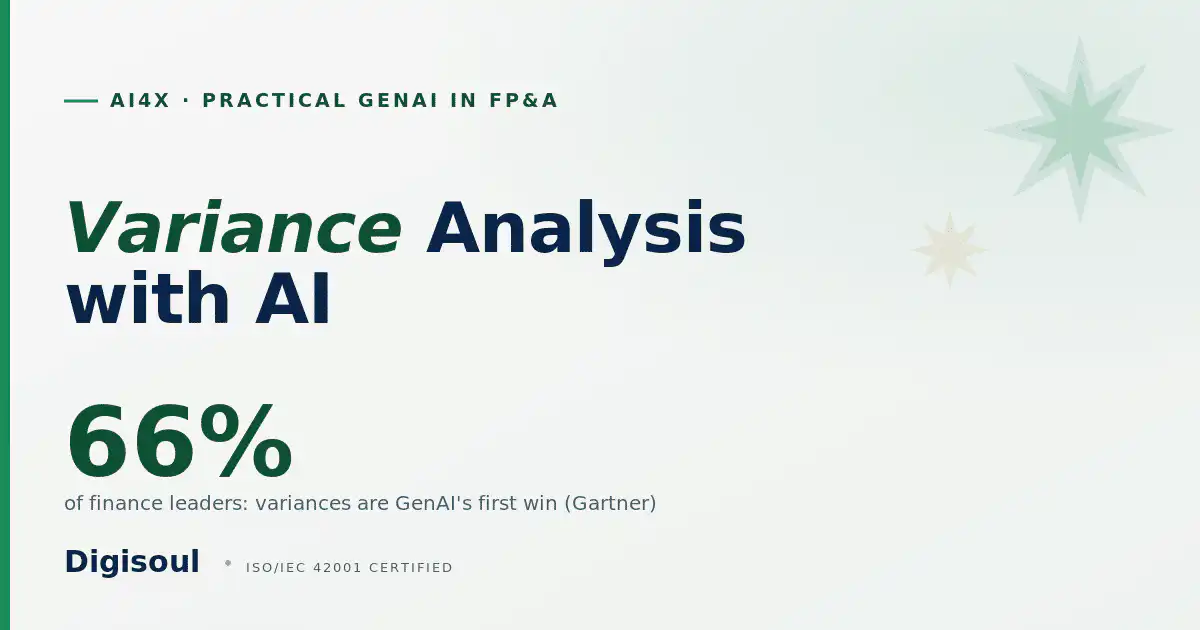
This is the fastest, safest place to start with GenAI in FP&A, and the market agrees: Gartner found 66% of finance leaders expect explaining forecast and budget variances to be generative AI’s most immediate impact. Below is a seven-step method you can defend to a CFO. It sits inside the wider GenAI FP&A operating model.
of finance leaders say explaining variances is GenAI's most immediate impact
Why variance analysis is the right first workflow#
Variance commentary is repetitive, language-heavy, and bounded by data you already trust. That is the ideal shape for generative AI: high drafting effort, clear source of truth, human reviewer on hand. It is also where FP&A loses time it would rather spend on analysis: across more than 430 finance professionals, only about a quarter of FP&A time reaches value-added analysis, the rest going to gathering data and administering process (AFP and APQC).
Where FP&A analysts' time goes
The pay-off is now measurable. Finance teams adopting AI report it returning an average of 21 hours per week to operations staff, with 75% of finance leaders seeing fewer errors (BILL, 2026 State of AI in Finance). The bridge below is the picture AI drafts the words for; hover any driver to see the explanation.
A variance bridge, plan to actual
Hover a bar to read what drove the variance.
The 7 steps#
The 7-step method
1. Prepare a clean actuals-vs-plan table
Lay out actuals, plan or prior, the variance, and the percentage, with consistent signs and clear labels. AI explains what you give it, so a clean table is your best defence against a fluent but wrong narrative.
2. Set a materiality threshold
Tell the model what counts. A rule like “explain any line over 5% and 50,000 EGP” keeps it on signal and stops it narrating noise.
3. Draft commentary with a structured prompt
Use Excel =COPILOT() or your enterprise model with a fixed prompt. A reusable template beats improvising every month and is the core of a standardised, tier-three workflow.
You are an FP&A analyst. Using only the table below, explain each variance above the materiality threshold, attributing it to an operational driver (volume, price, mix, timing). If you cannot explain a variance from the data, flag it. Output: one bullet per line, plus a three-sentence executive summary.
Anatomy of a variance prompt
4. Force driver-based reasoning
Require attribution to a driver, not a restatement. “Revenue fell 6% because volume dropped while price held” is analysis; “revenue fell 6%” is not.
5. Verify every figure against the source
Check each cited number against the table. Treat the draft like an intern’s work: helpful, not trusted, until verified. This is the step that protects you.
6. Edit for tone and audience
Tighten to house style, cut hedging, and produce the board version and the business-partner version from the same draft.
7. Log the prompt, data, model, and sign-off
Record the prompt, the exact data, the model and version, and the approver. This audit log is what turns an AI-assisted number into one finance can stand behind.
Common mistakes to avoid#
- Trusting the draft. Models can flip a sign or invent a plausible driver. Verification is non-negotiable.
- Vague prompts. “Explain these variances” yields padding. Name the role, drivers, threshold, and format.
- No audit trail. Without a log, you cannot defend the output, and an auditor will not accept it. Keep the control even when you are moving fast. See the governance control set in GenAI for FP&A in MENA.
Can AI write the commentary end to end?#
For low-materiality, well-understood lines, a governed workflow can get very close to hands-off, with a human approving at the gate. For anything judgemental or board-facing, AI drafts and a person decides. That balance, AI on the drafting, humans on the judgement, is the whole point of doing this in a governed way.
Key takeaways
- AI drafts the variance narrative; you verify every figure and own the sign-off.
- Clean inputs and a materiality threshold prevent confident, wrong commentary.
- Force driver-based attribution so the narrative explains, not just restates.
- The audit log (prompt, data, model, approver) is what a CFO and an auditor will accept.
Questions, answered
Can AI write variance commentary on its own?
What is the best prompt for AI variance analysis?
How do I keep AI variance analysis audit-ready?
How much time does AI save on variance analysis and reporting?
Which tool should I use?
Dr. Ahmed El-Shamy
Co-founder, CEO and Dean of Education, Digisoul
Dr. Ahmed El-Shamy is Co-founder, CEO and Dean of Education at Digisoul. He has more than a decade across AI, fraud risk, and FP&A, and teaches Practical GenAI in FP&A bilingually across MENA, the GCC, and Africa, governed by Digisoul's ISO/IEC 42001:2023-certified AI Management System. Read the leadership profile.
Sources
- Gartner · 66% of finance leaders expect GenAI's most immediate impact on explaining forecast and budget variances (Jun 2024). https://www.gartner.com/en/newsroom/press-releases/2024-06-27-gartner-survey-shows-66-of-finance-leaders-think-generative-ai-will-have-most-immediate-impact-on-explaining-forecast-and-budget-variances1
- Vena (reporting AFP and APQC) · FP&A teams spend ~25% of time on value-added analysis. https://www.venasolutions.com/blog/time-spent-on-analysis
- FP&A Trends 2025 Survey · 46% of FP&A time still spent on data collection and validation. https://fpa-trends.com/article/2025-fpa-benchmarks-and-trends
- BILL · 2026 State of AI in Finance: AI saves an average of 21 hours per week; 75% report fewer errors. https://www.bill.com/blog/state-of-ai-finance-report-takeaways
AI Agent · Built on Claude · Operated on Zoho One