
Key answer
A successful enterprise GenAI rollout puts governance at the center, not at the end. You need reliable data, human review and an audit trail the board accepts, a sequenced set of use cases tied to value, and an operating model your team owns. Rollouts that bolt governance on after the build are the ones the audit committee stops.
A successful enterprise GenAI rollout is defined by where you put governance. Put it at the center and the rollout scales and survives audit. Bolt it on after the build and the audit committee stops the go-live, the data turns out to be ungoverned, and the program stalls. Governance is not the brake on an enterprise rollout. It is the thing that lets it move.
The rollouts that get stopped#
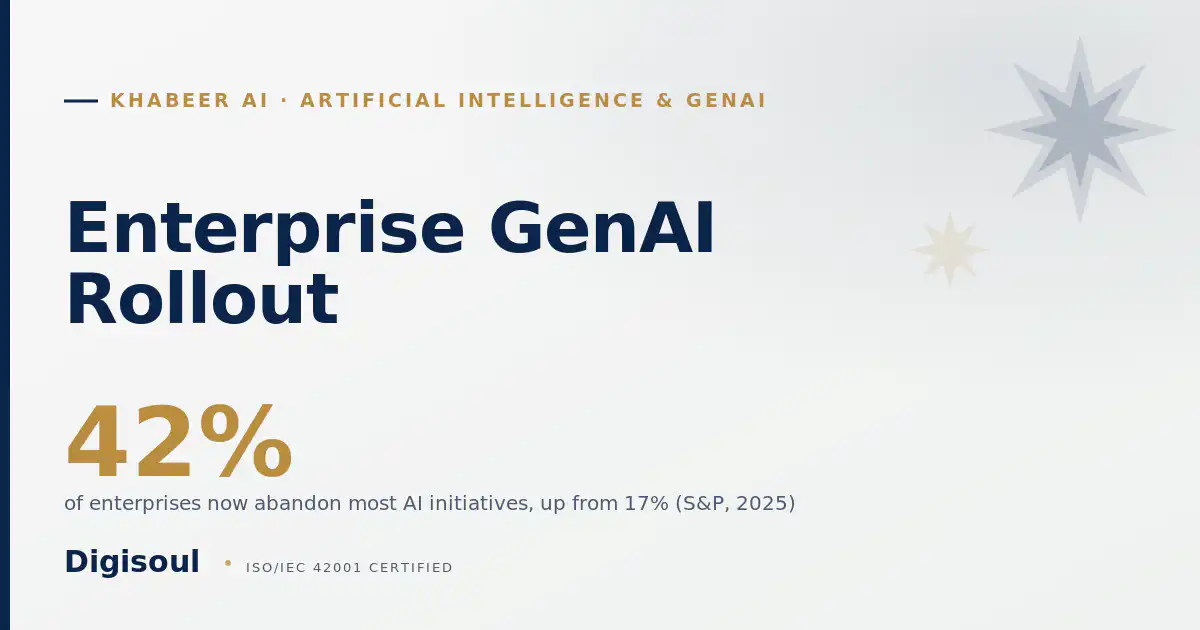
Plenty of organizations have funded enterprise GenAI and then watched it stall at scale. The reason is rarely the technology. It is that the rollout treated governance, data, and change as things to handle later. The market shows the cost: the share of enterprises abandoning most of their AI initiatives rose from 17% to 42% in a single year (S&P Global, 2025).
of enterprises now abandon most AI initiatives, up from 17% a year earlier
The deeper pattern sits underneath that number. Adoption is now near-universal, but governed value at scale is rare. McKinsey’s 2025 State of AI found 88% of organizations use AI in at least one function, yet only 39% report enterprise-level EBIT impact and just 7% have fully scaled it. Governance is the missing layer: Deloitte’s 2026 enterprise survey found that, among companies moving to agentic AI, only 21% have a mature model for governing those agents. The rollouts that scale are the ones that close that governance gap on purpose.
Adoption is wide; governed, scaled value is rare
Put governance at the center#
A rollout the board will approve is built on four controls, designed in from the first use case rather than retrofitted.
Governance at the center
You hold an inventory of every model and agent and who owns it. Human controls sit on the steps that matter. Evidence is audit-ready, so inputs, outputs, and decisions are traceable. And data access is least-privilege, with residency respected. These are not paperwork; they are what make scaling safe.
Roll out in sequence, not all at once#
Enterprise rollouts fail when they try to do everything everywhere. A governed rollout moves in order: a foundation of readiness, data, and the governance frame; two sequenced, controlled use cases; then scale by repeating the loop; and finally an operating model your team owns.
A governed rollout
This sequencing is the same discipline that gets a single pilot to production, applied across the enterprise. If you have not solved the single-pilot case yet, start with From Stalled Pilot to Production AI in 90 Days.
Designed MENA-native, owned by you#
Khabeer AI runs this as one governed lifecycle, independent and vendor-neutral, aligned to SDAIA expectations and informed by ISO/IEC 42001, with controls mapped to PDPL and your own policies. Everything is yours to own: documented, governed, and ready for your team to run and extend. The starting point is a scoped plan across readiness, build, governance, and the operating model, with gates you approve before any build.
Key takeaways
- Governance belongs at the center of a rollout, not bolted on after the build.
- Know every model and agent, who owns it, and how its decisions are traced.
- Roll out in sequence: foundation, two use cases, then scale, with controls throughout.
- Finish with an operating model your team owns, aligned to SDAIA and informed by ISO/IEC 42001.
Questions, answered
What makes an enterprise GenAI rollout succeed?
How do we satisfy the audit committee?
How does this fit MENA requirements?
Will we depend on you to run it?
Dr. Ahmed El-Shamy
Co-founder, CEO and Dean of Education, Digisoul
Dr. Ahmed El-Shamy is Co-founder, CEO and Dean of Education at Digisoul. He has more than a decade across AI, fraud risk, and FP&A, and teaches Practical GenAI in FP&A bilingually across MENA, the GCC, and Africa, governed by Digisoul's ISO/IEC 42001:2023-certified AI Management System. Read the leadership profile.
Sources
- S&P Global Market Intelligence (2025): share of companies abandoning most AI initiatives rose to 42%, from 17% a year earlier. https://www.spglobal.com/market-intelligence/en/news-insights/research/2025/10/generative-ai-shows-rapid-growth-but-yields-mixed-results
- McKinsey, The State of AI (Nov 2025): 88% of organisations use AI in at least one function, but only 39% report enterprise-level EBIT impact and just 7% have fully scaled it. https://www.mckinsey.com/capabilities/quantumblack/our-insights/the-state-of-ai
- Deloitte, State of AI in the Enterprise 2026 (The Untapped Edge): only 21% of companies planning agentic AI report a mature model for agent governance. https://www.deloitte.com/us/en/about/press-room/state-of-ai-report-2026.html
- MIT (NANDA), State of AI in Business 2025, via Fortune: ~95% of enterprise GenAI pilots fail to deliver measurable impact. https://fortune.com/2025/08/18/mit-report-95-percent-generative-ai-pilots-at-companies-failing-cfo/
- Digisoul AI Governance and AIMS (ISO/IEC 42001:2023 certified). https://digisoul.io/ai-governance-aims/
AI Agent · Built on Claude · Operated on Zoho One