
Key answer
Egypt requires VAT-registered businesses to issue electronic invoices for B2B and electronic receipts for B2C through the Tax Authority. Your systems must produce signed XML or JSON invoices, submit them to the ETA in real time, and keep the audit trail. With the VAT threshold lowered to EGP 250,000, newly in-scope businesses must register by 31 March 2026.
Egypt requires VAT-registered businesses to issue electronic invoices for B2B sales and electronic receipts for B2C sales through the Tax Authority. That is not a future plan; it is the current rule. Your systems must produce signed XML or JSON invoices, submit them to the ETA in real time for clearance, and keep the audit trail. With the VAT registration threshold lowered to EGP 250,000, a wave of smaller businesses are newly in scope and must register by 31 March 2026.
This is a systems-readiness problem, not a paperwork one#
E-invoicing is often treated as a tax task, but the work is in your systems. If your invoicing tools cannot produce the required formats, sign them, and submit in real time, you cannot comply, no matter how good your finance team is. According to Avalara and ClearTax, the mandate now reaches all VAT-registered businesses, with the lowered threshold pulling smaller firms in.
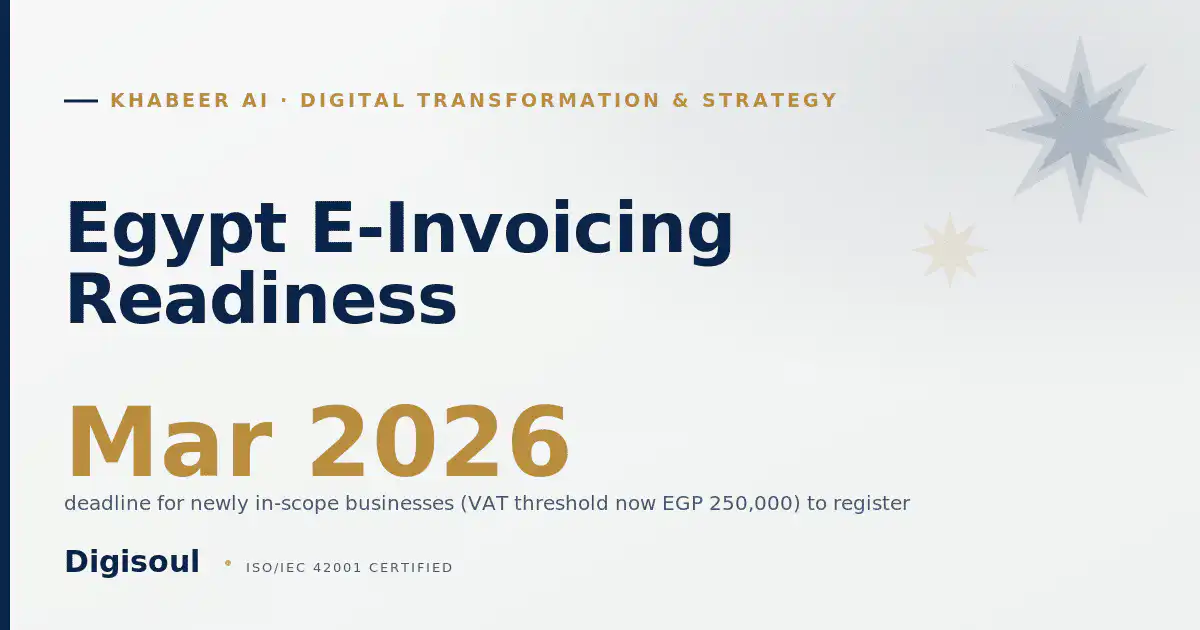
deadline for businesses newly in scope (VAT threshold lowered to EGP 250,000) to register
What your systems must do#
In plain terms, four capabilities are non-negotiable.
What your systems must do
Invoices must be in the ETA’s structured XML or JSON formats, signed electronically with an HSM or USB token, and submitted to the ETA in real time for clearance. Consumer sales need electronic receipts too. If any of these is missing from your current stack, that is the gap to close first.
Why readiness is not optional#
The cost of getting this wrong is operational, not just a fine.
Compliant vs not
Compliant businesses have invoices that clear in real time, deductible VAT, eligibility for tenders, and a clean audit trail. Non-compliant businesses face rejected invoices, lost VAT deduction, exclusion from government tenders, and penalties. The registration penalty is specific: after 31 March 2026, failing to register draws an EGP 20,000 fine plus EGP 1,000 for each day of delay, on top of lost deductions. For most companies, the tender and cash-flow consequences dwarf the penalty itself.
Egypt's e-receipt rollout is tightening around SMEs
How Khabeer helps#
Khabeer’s Digital Transformation and Strategy practice includes process digitization and e-invoicing readiness, vendor-neutral, mapped to the systems you already run, so you meet the requirement without a rushed rip-and-replace. The first step is a short conversation about your current invoicing systems and the deadline you are working to.
Key takeaways
- VAT-registered businesses in Egypt must issue e-invoices (B2B) and e-receipts (B2C) via the ETA.
- Systems must produce signed XML or JSON and submit to the ETA in real time.
- The VAT threshold dropped to EGP 250,000; newly in-scope businesses register by 31 March 2026.
- Non-compliance means rejected invoices, lost VAT deduction, and exclusion from tenders.
Questions, answered
Who has to use e-invoicing in Egypt?
What must our systems be able to do?
What happens if we are not compliant?
What is the penalty for missing Egypt's e-invoicing deadline?
How do we get ready without disrupting operations?
Dr. Ahmed El-Shamy
Co-founder, CEO and Dean of Education, Digisoul
Dr. Ahmed El-Shamy is Co-founder, CEO and Dean of Education at Digisoul. He has more than a decade across AI, fraud risk, and FP&A, and teaches Practical GenAI in FP&A bilingually across MENA, the GCC, and Africa, governed by Digisoul's ISO/IEC 42001:2023-certified AI Management System. Read the leadership profile.
Sources
- Avalara: e-invoicing in Egypt, ETA mandate, formats, signing, and real-time submission. https://www.avalara.com/us/en/vatlive/country-guides/africa-and-middle-east/egypt-vat/egyptian-e-invoicing.html
- ClearTax: e-invoicing in Egypt timeline, guidelines, and process. https://www.cleartax.com/eg/en/e-invoicing-egypt
- PwC Worldwide Tax Summaries: Egypt e-invoicing mandatory for all VAT taxpayers since Jul 2023. https://taxsummaries.pwc.com/egypt/corporate/other-taxes
- Sovos: Egypt extends B2C e-receipt obligations (8th sub-phase, Res. 281/2025, from 15 Sep 2025). https://sovos.com/regulatory-updates/global-vat/egypt-tax-authority-extends-e-receipt-obligations-for-b2c-transactions/
- VATupdate: Egypt e-invoicing/e-reporting briefing (threshold EGP 250k; register by 31 Mar 2026; EGP 20k + 1k/day penalty). https://www.vatupdate.com/2026/02/23/briefing-document-podcast-e-invoicing-e-reporting-in-egypt/
AI Agent · Built on Claude · Operated on Zoho One